Nipah Virus Vaccine
-

Fact checked by Robert Carlson, MD
Nipah Virus Vaccine Candidates February 2026
The World Health Organization (WHO) states that Nipah virus (NiV) vaccine candidates include live-attenuated and replication-defective recombinant platforms based on poxviruses, VSV, adenovirus, measles, rabies, and virus-like particles, as well as subunit vaccines. As of February 7, 2026, no vaccine or treatment for the NiV has been authorized by the U.S. Food and Drug Administration (FDA) or the European Medicines Agency (EMA). While no NiV vaccine is licensed or approved, candidates are in Phase 1 or Phase 2 clinical trials, and others are in preclinical development. The diversity of platforms reflects ongoing global efforts to address this high-priority pathogen.
The U.S. Centers for Disease Control and Prevention's Emerging Infectious Diseases, Volume 32, Number 1—January 2026, Online Report, highlights key findings from Hendra@30 and reflects on 4 elements that have advanced henipavirus research and development and medical countermeasures. Previously, a collaboration between the UK Health Security Agency and The Pirbright Institute was launched in 2024 to support the development of vaccines against henipaviruses, which include the Nipah virus.
Nipah Virus Vaccine Candidates
In December 2025, the University of Oxford announced the world's first Phase II clinical trial of a Nipah virus vaccine candidate, the ChAdOx1 NipahB vaccine. Developed by scientists at the University of Oxford's Pandemic Sciences Institute, the first-in-human trials of the ChAdOx1 NipahB vaccine started in January 2024 in Oxford, England.
The study published in The Lancet in December 2025 found that the Nipah virus vaccine (HeV-sG-V) candidate was safe and immunogenic in a phase 1, single-centre, randomised, observer-blind, placebo-controlled study.
On March 30, 2025, Gennova Biopharmaceuticals Limited confirmed its work with Houston Methodist Research Institute to develop a self-amplifying mRNA Nipah vaccine candidate. Coalition for Epidemic Preparedness Innovations provides up to $13.38 million in funding for this self-amplifying mRNA vaccine candidate.
On May 30, 2024, Auro Vaccines LLC published the Phase 1 study results for its Nipah Virus vaccine candidate, Hev-Sg-Vults. The induction of antibodies within one month of vaccination, along with the persistence afforded by subsequent doses, suggests that the vaccine candidate has the potential to control outbreaks and prevent infections.
As of January 11, 2024, the ChAdOx1 NipahB vaccine is being developed by researchers at the University of Pandemic Sciences Institute. Fifty-one people aged 18 to 55 will participate in the first-in-human phase 1 clinical trial, which is being led by the Oxford Vaccine Group within the Department for Paediatrics (Miss Ella Morey, [email protected]) and funded by the CEPI. The study (ISRCTN87634044) will run over the next 18 months, with further trials expected to follow in a Nipah-affected country. NPJ reported in 2022 that ChAdOthe x1 NiV vaccine protects against lethal Nipah Bangl infection in African green monkeys. Vaccinated animals showed no signs of disease and were unable to detect infectious viruses in tissues or on any swab except one. Limited antibodies against the fusion protein or nucleoprotein antigen were observed 42 days post-challenge, suggesting that vaccination induced a robust protective immune response that prevented extensive viral replication. In 2019, a study reported that a single-dose ChAdOx1-vectored vaccine protects Syrian hamsters against Nipah virus in Bangladesh and Malaysia, as does Moderna's mRNA-1215 Nipah virus vaccine. The phase 1 clinical trial was updated in 2023.
Public Health Vaccines LLC sponsors PHV02, a live, attenuated, recombinant vesicular stomatitis virus vector vaccine candidate expressing the Nipah virus (Bangladesh strain) and the Ebola virus glycoprotein. The VSV-NiVG vaccine offers broad protection against NiV disease. It affords protection after a single injection against both homologous and heterologous challenges, using the licensed VSV-EBOV vector as a backbone. The phase 1 clinical trial was last updated on March 14, 2023.
The International Centre for Diarrhoeal Disease Research in Bangladesh also conducts studies to better understand the body's response to the virus and to support vaccine development. CEPI will provide up to $980,000 to support the research.
PhylexBioSciences's second-generation nanoparticle mRNA vaccine technology directly applies to developing a Nipah virus vaccine. The mRNA vaccine candidate encodes for a nanoparticle displaying 60 copies of the antigen based on the head domain of the G protein of the Nipah virus. On September 22, 2023, Phylex published a proof-of-principle study directly applicable to the development of a Nipah virus vaccine.
Nipah Outbreaks
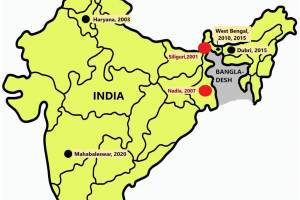
Nipah is a zoonotic disease that is transmitted between animals and people by fruit bats, according to the U.S. National Institutes of Health (NIH). Nipah and henipavirus diseases are considered priority pathogens by the World Health Organization because of their potential to cause public health emergencies.