


Search API
With over 13,000 Americans visiting Samoa in 2024 and more people arriving in 2025, the U.S. Department of State evaluated its travel advisory for the Independent State of Samoa.
On March 10, 2025, the State Department reissued a Level 1: Exercise Normal Precautions, Travel Advisory for Samoa, an island country in Polynesia. There is a country-wide population of about 200,000 in Savai'i and Upolu and on the smaller islands of Manono and Apolima.
Often confused with American Samoa, an unincorporated territory of the U.S., Samoa, previously known as Western Samoa, is about 100 miles away.
According to the local tourist board, the impact of Map Samoa has been profound. It has simplified travel planning, making it easier for tourists and visitors to discover and explore Samoa's hidden gems.
Suppose you decide to visit this Pacific Ocean paradise in 2025. In that case, the local U.S. embassy suggests enrolling in the Smart Traveler Enrollment Program to receive digital alerts and to ensure you can be located in an emergency.
From a health perspective, the U.S. CDC has not included Samoa in its recent travel advisories.
"Samoa promises South Pacific travelers an idyllic beach escape, yet visitors must prioritize health precautions against food- and waterborne diseases like typhoid fever and hepatitis A," Jeri Beales MSN, RN, BS, informed Vax-Before-Travel News.
"With the Samoan government launching a typhoid vaccination campaign for its citizens in 2021 and 2022 due to elevated infection rates, it's clear this is a serious local concern—making pre-travel vaccinations for visitors all the more essential," added Beales, who leads the Massachusetts-based Destination Health Travel Clinic.
As of March 2025, the CDC recommends that future visitors to Samoa speak with a vaccination expert about route and travel vaccine options for diseases such as measles, typhoid, and yellow fever.
Note: This VBT news article was updated on March 16, 2025, to include vaccine expert insight.

A South Korean vaccine and biotech company announced today that it has shipped its self-developed influenza vaccine to countries in the Southern Hemisphere ahead of the arrival of the new flu season.
SK bioscience confirmed on March 12, 2025, that it has begun shipping SKYCellflu to Southeast Asia and Latin America markets. A total of 750,000 doses will be supplied to countries in these markets in the first half of 2025.
SKYCellflu is the world's first cell culture-based influenza vaccine to obtain WHO Prequalification.
SK bioscience's advanced technology offers key advantages over traditional egg-based production. For example, there is a reduced risk of viral mutations during manufacturing, which results in better strain matching with circulating viruses. Additionally, cell culture technology allows for a shorter production timeline, enabling faster response during outbreaks or pandemics.
This shipment marks the company's second export of influenza vaccines for Southern Hemisphere use, following its initial export to Thailand in 2024. Although Thailand is geographically located in the Northern Hemisphere, it follows both WHO's flu vaccination guidelines for the Northern and Southern Hemispheres due to its north-south span.
About 100 million flu shots were distributed in the United States for the 2024-2025 influenza season.

International travelers visiting countries in Africa in 2025 should be aware of the health risks associated with the ongoing cholera outbreak.
Cholera is a potentially fatal infection that causes severe diarrhea but can be prevented with vaccination.
While cholera is no longer a health risk in the United Kingdom (UK), it is sometimes reported in returning travellers from three WHO regions.
For example, the UK's Travel Health Pro reported on March 7, 2025, that four cases of cholera (toxigenic Vibrio cholerae serogroup O1) were locally diagnosed in mid-February 2025.
Three UK travellers were recently diagnosed with cholera after visiting the Federal Democratic Republic of Ethiopia.
A fourth UK cholera case did not travel but reported consuming water from Ethiopia by one of the returned travellers before experiencing symptoms.
Ethiopia is just one of 22 areas the WHO currently identifies as a risk for cholera.
A cholera vaccine can be considered for travellers departing from the UK following a full risk assessment and those with limited access to safe water and/or underlying health problems.
According to the U.S. CDC, cholera remains a global health risk.
And when leaving the United States in March 2025, the U.S. CDC recommends that travelers speak with a travel vaccine expert about cholera prevention options. Following increased production, cholera vaccines have become more available this year.

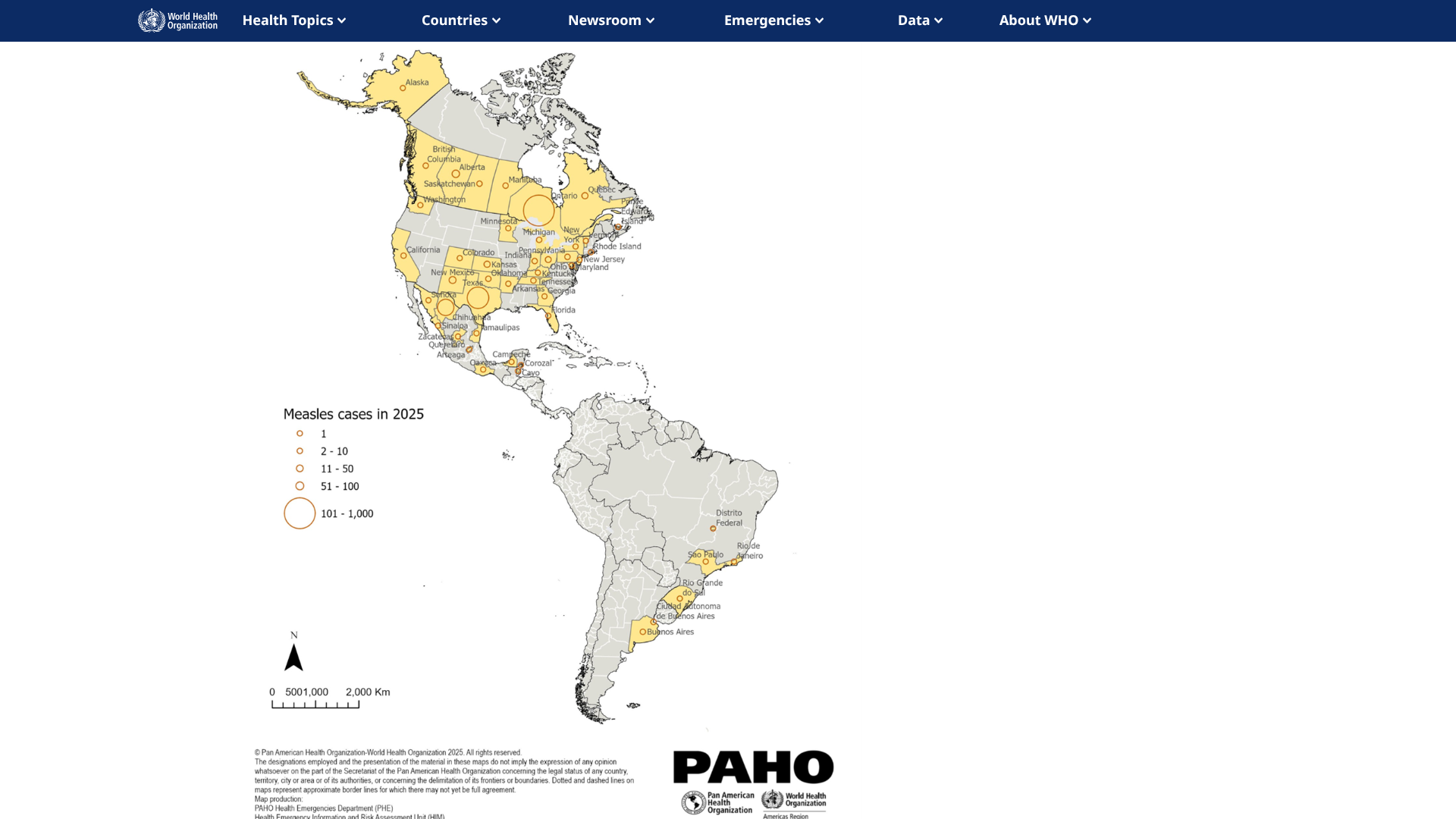
Since early 2025, New Mexico and Texas have reported an unexpected number of measles cases, mainly in rural counties.
As of March 11, 2025, the state of Oklahoma was added to this geographic health outbreak.
The Oklahoma State Department of Health (OSDH) confirmed two measles cases in a press release but did not disclose the actual locations.
“These cases highlight the importance of being aware of measles activity as people travel or host visitors,” Kendra Dougherty, Director of Infectious Disease Prevention and Response at OSDH said.
As of March 6, 2025, the U.S. CDC reported 222 measles cases in 12 jurisdictions this year.
These measles cases may be related to the ongoing global measles outbreak in 2025.
In a recent CDC Health Alert Network, the agency wrote that the risk for widespread measles in the United States remains low due to robust U.S. immunization and surveillance programs.
The CDC says healthcare providers should ensure all patients without other evidence of immunity, especially those planning international travel, are up to date on the MMR vaccine, which is offered at most pharmacies in the U.S.

Brazil's Ministry of Health (MOH) has been reporting data on the locations of Chikungunya patients for the past three years.
As of March 11, 2025, the MOH reported that most of the 40,000 Chikungunya cases reported this year were found in Sao Paulo (5,714) and Minus Gerias (5,120).
Last year, there were about 265,000 Chikungunya cases and 231 related fatalities in Brazil, located in similar states.
The Chikungunya virus is transmitted to people through the bite of an infected mosquito of the Aedes spp., which are found at beaches and in mountains below seven thousand feet in elevation.
While the U.S. CDC has not issued a Travel Health Advisory regarding Brazil's ongoing Chikungunya outbreak, it writes, 'There has been evidence of chikungunya virus transmission in Brazil within the last five years.'
Chikungunya vaccination may be considered for seniors, especially those with underlying medical conditions, who may spend at least two weeks (cumulative time) in indoor or outdoor areas where mosquitoes are present in Brazil, or visitors planning to stay in Brazil for a cumulative period of six months or more.
Before departing for Brazil, most travel clinics and pharmacies in the United States offer the U.S. FDA-approved chikungunya vaccine. Valneva SE's IXCHIQ® vaccine has been found safe and effective in various studies.

While the Kingdom of Morocco is not listed in the U.S. CDC's recent Global Measles Health Advisory, it has been experiencing a significant measles outbreak since late 2023.
According to media reports citing official sources, about 3,600 measles cases and five deaths have been reported in 2025. Since Morocco's outbreak began, there have been about 20,000 cases.
Amine Tahraoui, the Ministry of Health, says the reasons for the increase in measles cases are unknown.
On February 6, 2025, the Minister reviewed the disease status in Morocco and the strategy adopted to combat it. He stated that his department has implemented a multi-faceted plan to curb the spread of measles.
He specified that this plan includes extending the national vaccination campaign and catching up on missed vaccinations, which has enabled the verification of the vaccination status of more than 8.88 million children.
The Moroccan Ministry of Health also extended the vaccination campaign until March 28, 2025, to ensure everyone (37 million residents) can access essential vaccines.
The CDC recommends that all international travelers visiting Morocco be fully vaccinated against measles with the measles, mumps, and rubella (MMR) vaccine, including an early dose for infants.
In addition to the MMR, the CDC recommends various routine and travel vaccines before visiting Morocco in 2025. These vaccines are generally offered in the United States at travel clinics and pharmacies.

The Ministry of Health for the State of São Paulo recently confirmed its first patient infected with Mpox Clade 1b. The infection was confirmed in early March 2025 in an adult woman in the Metropolitan Region of São Paulo.
According to the media statement of March 10, 2025, she is expected to be discharged next week.
The patient had not traveled to outbreak areas in Africa but had contact with individuals from the Democratic Republic of Congo, where the virus is endemic.
"No secondary cases have been identified as yet. The municipal surveillance team is keeping track of possible contacts," the Ministry's Edjalma Borg statement reads.
Mpox has been considered endemic in Africa since the 1970s.
In May 2022, Mpox Clade 2 cases were detected in numerous countries, including the United States. Since July 2024, cases of Clade 1b have been identified in several countries, such as England.
According to various studies, Mpox vaccinations help prevent severe disease.

With the U.S. CDC reissuing a Global Measles Travel Advisory for 57 countries in February 2025, public health leaders are concerned that unvaccinated travelers may bring this highly infectious disease into Texas schools.
Following the city’s first confirmed measles cases since 2018, Houston Public Health issued an alert in February 2025, encouraging everyone to ensure their protection, and launched vaccination campaigns.
A real-time example of this risk is the Houston Livestock Show and Rodeo, which welcomes tens of thousands of out-of-town visitors to Texas daily. This family-friendly event enhances the lives of young people each March, but it could become a disease hot spot for unvaccinated children.
Houston Public Media recently reported that a few private schools in the Houston area are among the Texas institutions with the lowest measles vaccination rates, according to data compiled by the Texas Department of State Health Services (DSHS).
Immunization data from more than 1,600 surveyed public and private schools in Texas shows that 50% or fewer kindergarteners in some private schools in Harris and Montgomery counties were vaccinated for measles during the 2023-24 school year.
As of March 7, 2025, Houston Public Media found that about 36% of kindergarteners at the Acton Leadership Academy of Magnolia were vaccinated for measles in 2023-24.
Acton Leadership Academy of Creekside, located in Spring, also had a 50% measles vaccination rate in its kindergarten class.
Positive data exists across the state: About 92% of kindergarteners at 1,680 surveyed Texas public and private schools were immunized for measles during the 2023-24 school year.
However, in Texas, vaccination exemptions are approved for two reasons: if a physician states the vaccine could pose a health risk to the student, or if the student’s parents have a religious or personal belief that opposes getting vaccinated.
As of March 11, 2025, DSHS and the CDC encourage most people to get two doses of the MMR vaccine, which are generally available at health clinics and pharmacies throughout Texas.
