Search API
Every year, malaria-infected travelers return to the UK after visiting countries in Africa. Last year, 2,106 malaria cases, with six deaths, were reported in the UK by returning travelers. This data is 26% higher than confirmed in 2022.
With the winter holiday season licking off, UK health officials are preparing for an influx of malaria cases.
To better treat these people, the United Kingdom Health Security Agency (UKHSA) UK Malaria Expert Advisory Group recently published updated Malaria prevention guidelines for travelers from the UK.
This information is also helpful for travelers interested in antimalarial options.
As of December 3, 2024, the UKHSA says these enhanced malaria guidelines are a practical resource for health professionals advising travelers to Africa. Get pre-travel advice as soon as possible, ideally four to six weeks before you travel, although last-minute advice is still important if time is short.
While Heathrow Airport is England's busiest international depot, numerous healthcare providers are in the surrounding cities, ready to offer pre- and post-trip travel vaccine advice.
And for travel insights, malaria maps for the Central African Republic, Guyana, Nicaragua, and Venezuela have also been created, and an enhanced map for South Africa has been produced.
Also, as of December 9, 2024, two malaria vaccines are being offered in Africa, with limited distribution elsewhere.


The Pan American Health Organization (PAHO) is conducting a briefing on the current state of dengue, Oropouche, and avian flu in the Region of the Americas. These Arthropod-borne viruses pose a significant public health threat, with a notable expansion in their geographic spread.
Recently, the Oropouche virus has also expanded in certain countries, such as Cube, and avian flu has been reported in birds, mammals, and humans along the northern flyway.
On December 10, 2024, at 10:00 a.m. EST, via Zoom with prior registration, the PAHO will provide an update on the situation of these viruses and recommendations for 2025.
Since 2003, the Americas have faced an unprecedented increase in dengue outbreaks in 2024, with over 12.6 million infections and 7,713 related fatalities, marking a record year.
In the United States, the CDC reported that 52 jurisdictions, led by California, Florida, New Jersey, New York, and Puerto Rico, had reported 7,858 dengue cases this year. According to local reporting, dengue may have become endemic in Puerto Rico and Miami, Florida.
As of December 9, 2024, no dengue vaccine is available in the U.S.

The World Health Organization (WHO) today announced that between 24 October and 5 December 2024, the Panzi health zone in Kwango Province of the Democratic Republic of the Congo (DRC) recorded 406 cases of an undiagnosed disease with symptoms of fever, headache, cough, runny nose, and body ache.
Most cases reported are among children, particularly those under five years of age.
The WHO's Disease Outbreak News wrote on December 8, 2024, that 31 deaths had been registered.
Given the clinical presentation and symptoms reported so far and the number of associated deaths, acute pneumonia, influenza, COVID-19, measles, and malaria are considered potential causal factors, with malnutrition as a contributing factor.
Laboratory tests are underway to determine the exact cause. At this stage, it is also possible that more than one disease is contributing to the cases and deaths.
The WHO says the overall risk level to the affected DRC communities is assessed as high.
At the national level, the risk is considered moderate due to the localized nature of the outbreak within the Panzi health zone in Kwango province. However, the potential for spread to neighboring areas, coupled with gaps in surveillance and response systems, this assessment underscores the need for heightened preparedness.
At the regional and global levels, the risk remains low at this time.
However, the proximity of the affected area to the border with Angola raises concerns about potential cross-border transmission, and continued monitoring and cross-border coordination will be essential to mitigate this risk.
The current confidence in the available information remains moderate, as significant clinical, epidemiological, and laboratory data gaps persist.
One aspect of this new WHO report is that there are vaccines available for many of these suspected diseases.

The Florida Department of Health recently published its Arbovirus Surveillance Update 48, which discloses mosquito-borne disease activity, such as Dengue virus.
As of December 7, 2024, 70 cases of locally acquired dengue were reported from ten counties led by Miami-Dade (44). Most of this year's dengue cases are serotyped as DENV-3 and 4.
In 2023, 186 people contracted dengue in Florida.
This virus is transmitted to people by infected mosquitoes. Furthermore, women infected with dengue during pregnancy can pass the virus to their fetus.
As of today, the U.S. Centers for Disease Control and Prevention, Canada Health, and the United Kingdom have not issued vaccination requirements for visitors traveling to southeast Florida.
Dengue vaccines are available in numerous countries but not in the U.S.

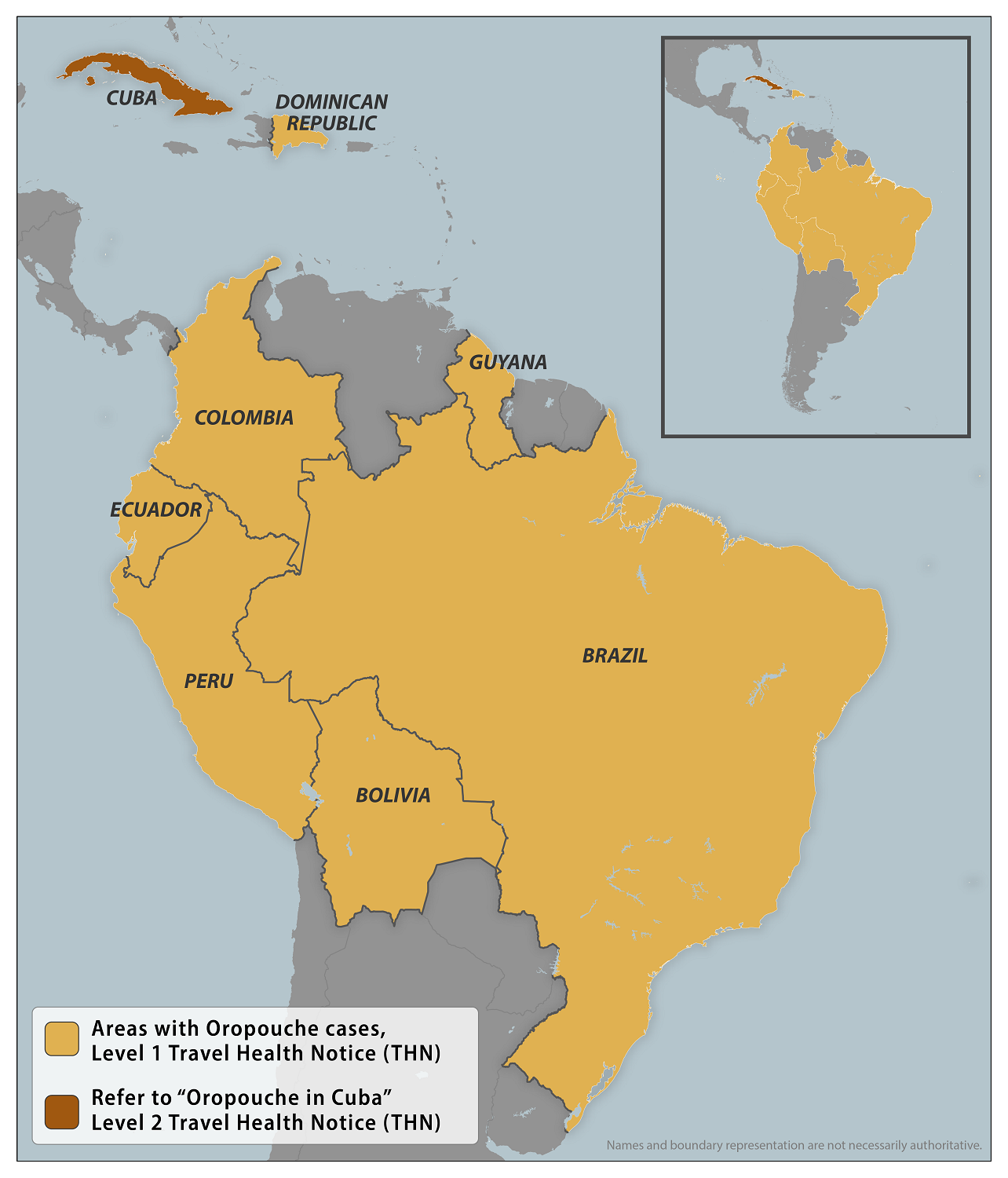
In the Region of the Americas, outbreaks of Oropouche virus disease have occurred historically in the Amazon region in rural and urban communities in Brazil, Colombia, Ciba, Ecuador, French Guiana, Panama, Peru, and Trinidad and Tobago.
On December 5, 2024, the World Health Organization (WHO) issued Disease Outbreak News regarding the current outbreak.
As of late November 2024, a total of 11,634 confirmed Oropouche cases, including two deaths, have been reported in the Region of the Americas across ten countries and one territory: Bolivia, Brazil, Canada, Cayman Islands, Colombia, Cuba, Ecuador, Guyana, Panama, Peru and the United States of America.
In the USA, the Florida Department of Health published its Arbovirus Surveillance Update 48 on November 30, 2024, revealing 90 travel-associated Oropouche fever cases have been reported this year in travelers to Cuba.
The WHO's News report highlights the need to strengthen epidemiological and entomological surveillance and reinforce the population's preventive measures.
This advice is crucial due to the expansion of the virus's transmission area and the growing need to understand better the disease spectrum, including possible new transmission routes. Oropouche is spread primarily by the bite of infected midges (small flies) and mosquitoes.
While it is unknown if Oropouche can be spread by sex, travelers to outbreak areas should take precautions during travel and for six weeks after returning to the USA from abroad.
According to the U.S. CDC, these vectors could affect the general population and vulnerable groups, such as pregnant women, their fetuses, and newborns.
Unfortunately, there are no Oropouche preventive vaccines available in 2024.
Based on available information, the WHO assesses the overall public health risk posed by the Oropouche virus as high at the regional level and low at the global level. Based on the current information on this event, WHO advises against applying travel or trade restrictions.
In Europe, dengue viruses, transmitted by Aedes albopictus mosquitoes, are primarily associated with infections acquired in endemic countries.
However, autochthonous (locally acquired) dengue cases have surged in the past five years, with significant reports from Spain, Croatia, France, and Italy. In 2023, Italy reported its highest-ever number of locally transmitted dengue virus cases.
The year 2023 was exceptional, not just due to the total number of reported cases but also for the uncommon co-occurrence of a few spatially disjointed autochthonous transmission chains of more than one DENV serotype, wrote researchers in an article published by the journal Nature on December 5, 2024.
The Italian National Public Health Authority reported 213 locally acquired dengue cases in 2024, a significant increase from the 82 confirmed cases last year.
Specifically, Italy's dengue outbreaks have become regionalized as infected mosquitoes spread the virus.
As of October 28, 2024, Eurosureliiance reported 138 confirmed and 61 probable cases of DENV-2 in Fano, a small coastal city in Italy's Marche Region.
With the holiday travel season fast approaching, Italy is anticipating additional dengue cases to be confirmed in 2024.
The U.S. CDC today published a Morbidity and Mortality Weekly Report that confirmed Nirsevimab (Beyfortus™), a U.S. FDA-approved monoclonal antibody that protects infants and young children against severe respiratory syncytial virus (RSV) infection, experienced significant uptake in New York City (NYC).
Among infants born in NYC during the recommended nirsevimab administration period for the 2023–24 RSV season and who reportedly received nirsevimab, 37% of Vaccines for Children (VFC)–eligible and 45% of non–VFC–eligible infants received it within the first 7 days of life.
These authors wrote on December 5, 2024, 'Ensuring birthing hospital VFC enrollment and establishing protocols to offer nirsevimab to eligible infants before hospital discharge might increase nirsevimab administration within the first week of life.'
Furthermore, Beyfortus has been found to be very protective.
On November 26, 2024, a study published by The Pediatric Infectious Disease Journal concluded that in immunized infants, RSV-positive bronchiolitis was less frequent and less severe, with a significantly reduced hospitalization length than in nonimmunized infants, producing substantial healthcare cost savings.