Search API
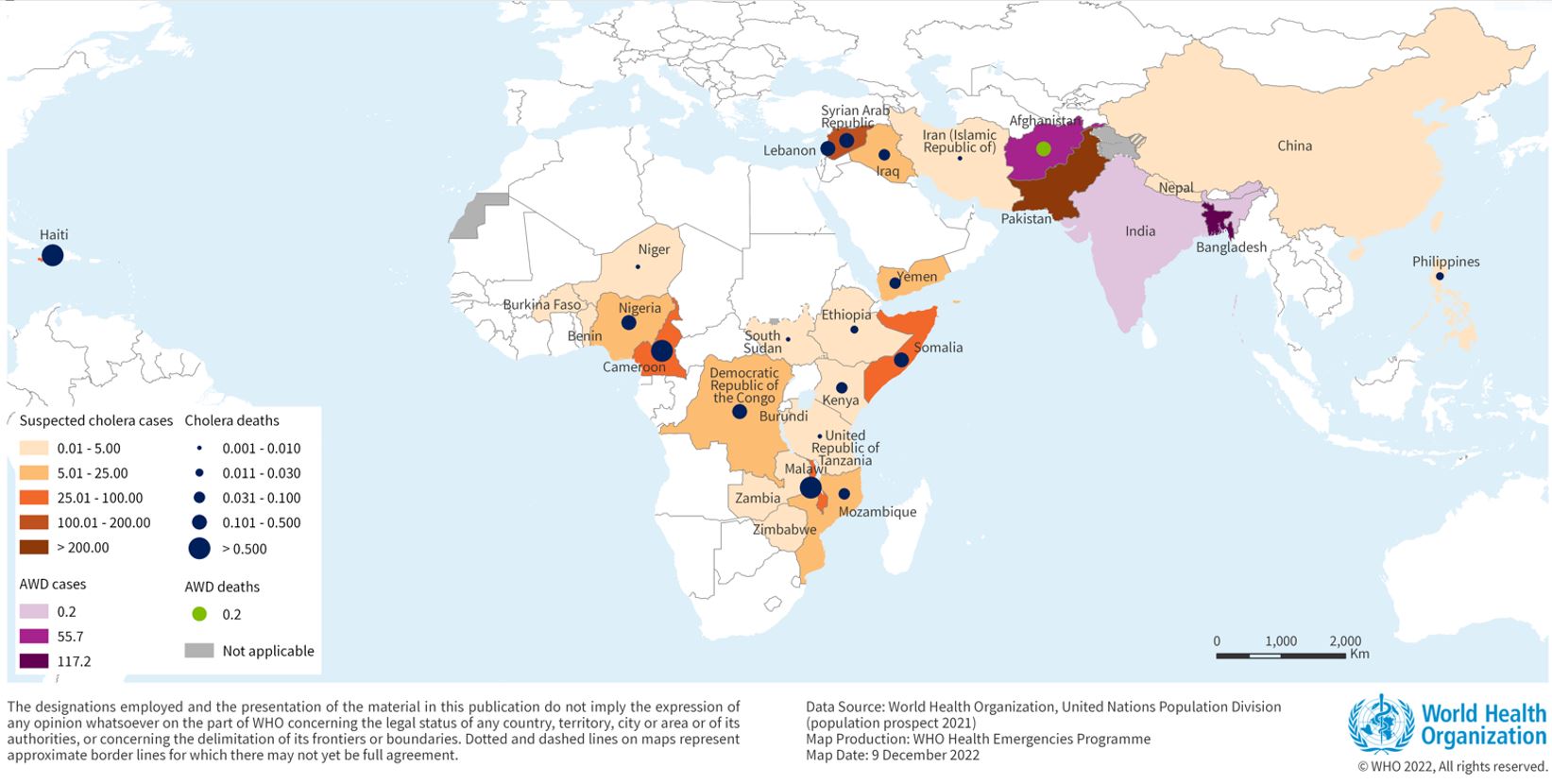
Since the last World Health Organization (WHO) report, new cholera outbreaks have been reported in Niger and Thailand, pushing the total number of affected countries in 2024 to 30.
As of the end of September 2024, a cumulative total of 439,724 cholera cases and 3,432 deaths were reported across five WHO regions.
Although the number of cases is lower than last year, the 126% spike in deaths is deeply concerning, says the WHO.
Unfortunately, the WHO has reported that as of October 14, 2024, the global stockpile of Oral Cholera Vaccine (OCV) is depleted, with no remaining doses available.
However, in the United States, travel vaccine clinics and pharmacies have confirmed supplies of OCVs.
With the global expansion of the chikungunya, dengue, and zika viruses in 2024, many publishers are challenged to present outbreak data in a balanced voice and tone in the media.
The lessons learned from the recent pandemic indicate that people want to read the data as soon as possible, whether published as a pre-print or peer-reviewed. With new information, people can privately confer with their healthcare providers about personal health actions such as vaccination.
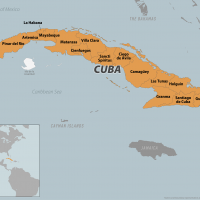
A recent Editorial published by The Lancet Infectious Diseases on October 15, 2024, encapsulated these concerns regarding the sudden Oropouche virus outbreak in the Region of the Americas, such as in Brazil and Cuba.
These researchers wrote, "While such early data are key to understanding and tackling outbreaks, they come with considerable uncertainty and raise questions about how to report and publish them responsibly."
"However, we believe knowledge will inform public health responses, focus resources, and garner urgency in studying the virus further, which is the first step to prevention and treatment."
The full, unedited Editorial is posted at this link.

The steady progress towards a polio-free world has been successful for over three and a half decades. According to a recent announcement, the achievement of this goal has been delayed.
The Global Polio Eradication Initiative (GPEI) announced on October 17, 2024, that billions of children have been protected with lifesaving immunizations. More than 20 million people are walking who would otherwise have been paralyzed by this dreadful disease.
The polio program is now concentrated in some of the most complicated and fragile settings to deliver essential healthcare.
Recognizing these challenges, the GPEI’s Polio Oversight Board decided in July 2024 to extend the timelines needed to achieve polio eradication to the end of 2027 for wild poliovirus.
And the end of 2029 for type 2 variant poliovirus.
The Board's decision was informed by critical analysis and expert consultations, and extended timelines require additional financial resources to support ongoing eradication activities.
These shifts are being driven by partners' expertise and a program-wide commitment to double down on the toughest but most critical challenges standing between us and a future without polio, wrote the GPEI.
On October 17, 2024, the U.S. Centers for Disease Control and Prevention (CDC) reported poliovirus outbreaks that had caused 672 confirmed polio cases over the past year and a half.
The CDC also reissued a Global Travel Health Notice in August 2024 to alert international travelers, confirming 37 countries report poliovirus detections. People are encouraged to speak with a travel vaccine expert at least one month before visiting any of these countries about immunization options.

Blue Lake Biotechnology, Inc. and its affiliate CyanVac LLC today announced the presentation of positive interim pediatric clinical data on BLB201, Blue Lake’s vaccine candidate against respiratory syncytial virus (RSV).
Hong Jin, Ph.D., Chief Scientific Officer of Blue Lake and CyanVac, presented a talk that included results from an interim analysis of RSV-seropositive children participating in the company’s ongoing Phase 1/2a pediatric study.
The data demonstrated the safety and immunogenicity of BLB201 in this population, including RSV F-specific systemic and mucosal antibody responses and cell-mediated immune responses in CD4+ and CD8+ T cells.
“Our vaccine approach is designed to stimulate potent immune responses from the humoral, cellular, and mucosal pillars of the immune system,” said Biao He, Ph.D., CEO of Blue Lake and CyanVac, in a press release on October 21, 2024.
“Many currently available vaccine technologies such as mRNA and protein-based vaccines are ineffective in inducing mucosal immunity because they are given intramuscularly."
"By robustly stimulating all three pillars of immunity, our intranasal vaccine may prevent disease transmission and generate longer-lasting immunity than other types of vaccines.”

When planning a European trip next year, many say the best time to visit Mediterranean Sea beaches is in the spring, when the weather is mild and before the summer crowds arrive.
Another consideration is when mosquitos transmit viruses such as dengue to vacationers.
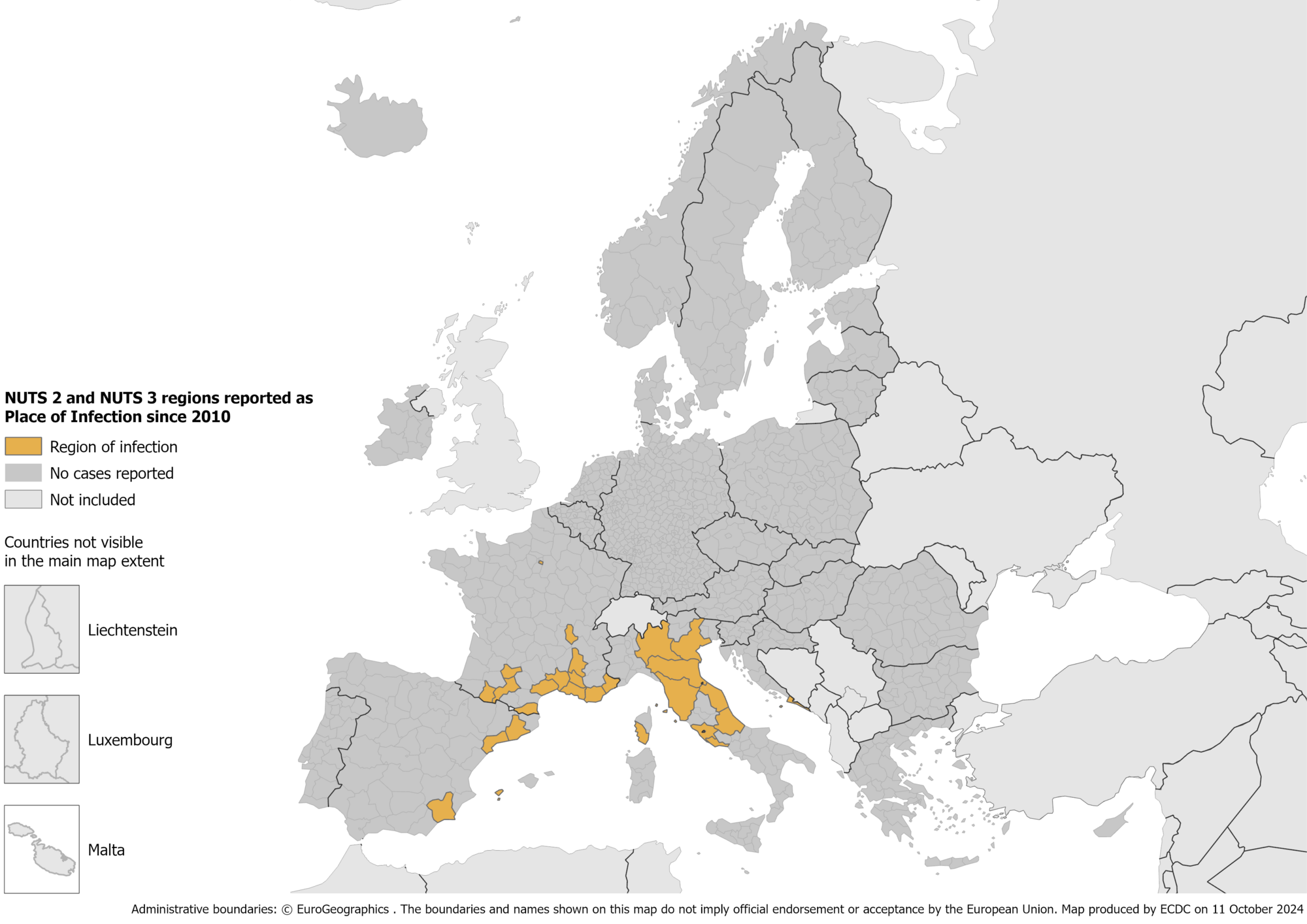
According to the European Centre for Disease Prevention and Control (ECDC), the recent three-month dengue outbreak rate measurably increased from July to September 2024.
As of October 2024, the ECDC reported locally acquired dengue cases in France, Italy, and Spain in 2024.
The Italian National Public Health Authority reported 194 locally acquired dengue cases in 2024. In 2023, 82 locally acquired dengue cases were reported.
In 2024, France reported 80 locally transmitted dengue fever cases and over 3,500 imported cases. In 2023, it reported nine dengue outbreaks that produced 45 autochthonous infections.
Spain reported eight locally acquired dengue cases in the Camp de Tarragona area of the Catalonia region in 2024. Last year, the Catalonia region reported just three local cases.
While unavailable in the United States, a second-generation dengue vaccine has been authorized in Europe since late 2022. Takeda's QDENGA vaccine remains approved in 2024 for use regardless of previous dengue exposure and without pre-vaccination testing.
The ECDC, U.S. CDC, and the WHO encourage travelers to speak with a travel vaccine expert about options to protect themselves from disease one month before departure.
The U.S. Centers for Disease Control and Prevention (CDC) reissued a Global Travel Health Notice on October 15, 2024, regarding Dengue outbreaks reported in 27 countries in the Americas, Africa/Middle East, and Asia/Pacific Islands.
In the Region of the Americas, over 12,076,930 Dengue cases and 7,171 related deaths have been reported this year.
In the United States, the CDC reported that 50 jurisdictions had reported 6,164 Dengue cases as of October 17, 2024, already exceeding reports from 2023.
For example, the Florida Health Department recently reported over 595 travel-associated and 47 locally acquired Dengue cases throughout the state.
The Texas Department of State Health Services says mosquitoes that transmit Dengue fever are found in Texas, with (78) imported cases reported in 23 counties.
In California, the Los Angeles County Department of Public Health reported eight locally acquired Dengue cases in the San Gabriel Valley this year.
While Dengue is a vaccine-preventable disease, no vaccine is currently available in the U.S.
