Search API
For the second time in a month, the mosquito-transmitted dengue fever virus has been confirmed in a person in Southern California.
On November 1, 2023, the City of Long Beach Department of Health and Human Services (Health Department) reported one case of dengue in a resident who has not traveled outside the U.S.
This is the first non-travel-related case of dengue in Long Beach, which has reported five travel-related cases.
Long Beach is home to approximately 466,000 Californians.
According to the Health Department, the risk of local exposure remains low.
"The health and well-being of the community is our most important priority," commented Long Beach Mayor Rex Richardson in a press release.
"We are working closely with health officials and doing everything we can to prevent more (dengue) cases. We ask that everyone do their part by removing standing water on their property to help us control the mosquitoes in our neighborhoods."
For more local information, people are encouraged to visit longbeach.gov/dengue.
According to reports, over 4.2 million infections and about 3,000 dengue outbreak-related deaths have been reported from 79 countries/territories in the past year.
In the U.S., the state of Florida has reported the most travel-related and local dengue cases in 2023.
An earlier locally-acquired dengue case was reported in Pasadena, California.
Dengue is a disease that is spread by the bites of Aedes species mosquitoes. When a mosquito bites someone with one of dengue's four viruses in their blood, it can spread the virus to others.
The best way to protect oneself from dengue and other diseases spread by mosquitoes is to avoid mosquito bites.
Dengue vaccines are available in 2023, but there are various geographic limitations and/or testing requirements.

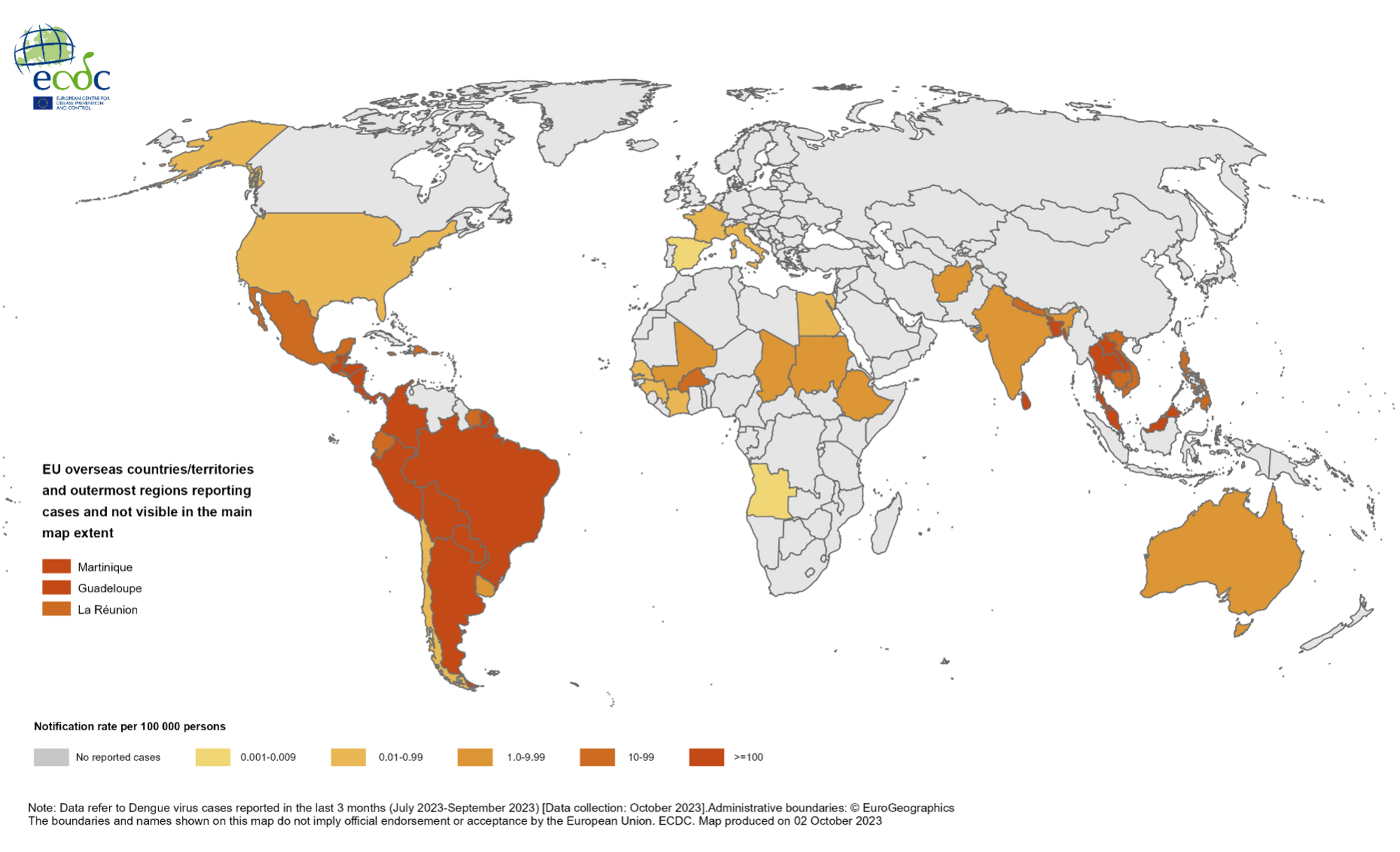
Throughout 2023, the global dengue outbreak has exceeded 4.2 million cases from 79 countries/territories, with the region of the Americas reporting the majority of cases.
Through September 2023, most dengue cases in the region were reported from Brazil and Peru; the latter is experiencing one of the most significant dengue outbreaks in its history, says the European Centre for Disease Prevention and Control.
In the United States, the state of Florida leads in reporting travel-related and locally acquired dengue cases.
As of October 28, 2023, Florida's Health Department confirmed its 513th dengue case of 2023.
Florida's Arbovirus Surveillance Report #43 confirmed 31 new travel-associated dengue cases. In 2023, 415 dengue cases associated with international travelers were reported. Two hundred and six of these cases are related to travel from Cuba.
From a long-term health perspective, health officials are very focused on the increase in locally acquired dengue cases.
Last week, 20 new cases of locally acquired dengue were reported in South Florida, increasing this year's total to 98.
Miami-Dade County has reported 91 of these locally acquired cases.
According to the U.S. Centers for Disease Control and Prevention, dengue is a vaccine-preventable disease that can progress to a severe condition.
As of October 31, 2023, two dengue vaccines are available globally, but only one is licensed in the U.S.
Dengvaxia is U.S. Food and Drug Administration-approved and indicated for preventing dengue virus serotypes 1, 2, 3, and 4. The Dengvaxia® vaccine is available for certain people following a pre-delivery diagnostic test review.

While the World Health Organization (WHO) Influenza Update N° 456 says respiratory syncytial virus (RSV) activity was generally low or decreasing globally, new data indicates the United States is seeing measurable increases.
The U.S. Centers for Disease Control and Prevention (CDC) RSV detection graphs showed increases throughout the U.S. as of October 27, 2023.
The National Respiratory and Enteric Virus Surveillance System (NREVSS) reports that the weekly percentage of RSV polymerase chain reaction (PCR) test positivity was 10.9% as of October 21, 2023.
During the 2022–2023 RSV season, positive test results peaked in November.
From an age perspective, the Weekly Emergency Department Visits chart clearly indicates that the most affected by this RSV season have been children under one-year-old.
In 2022, the JAMA Network conducted an Original Investigation that found 96 (95% CI, 92-99) RSV deaths among children younger than one year. And a study published by the Journal of Infectious Diseases determined that RSV-related deaths in infants <1 year peaked at about one month.
Furthermore, a meta-analysis of eleven studies published in October 2023 found that the meta-estimate of RSV-positive tests among pregnant women was 3.4% (95% CI: 1.9; 54).
According to the CDC, RSV has geographic trends in the U.S.
Florida's RSV season is longer than the rest of the country and has distinct regional patterns.
The Florida Department of Health reported as of week #42, October 21, 2023, RSV activity was increasing in hospital admissions and emergency room rates, with current outbreaks in Martin (1), Pinellas (2), and Volusia (1).
Fortunately, for the first time, there are approved RSV vaccines and passive immunizations available in the U.S. this season.

While two approved dengue vaccines are in use today, an innovative vaccine candidate was awarded $5.88 million to support activities to advance it into the clinic.
Codagenix Inc. announced on October 24, 2023, that the U.S. Department of Defense (DoD) awarded the Company $5,880,000 to advance the development of its CodaVax-DENV, a tetravalent live-attenuated dengue vaccine program.
The funds will support good manufacturing practices of drug substances and tetravalent drug product for a Phase 1 study, as well as a first-in-human Phase 1 safety and immunogenicity clinical trial.
This new award complements a $4.4 million DoD grant issued in 2022.
Codagenix's rational vaccine design platform is well-positioned to create a safe and effective dengue vaccine since its codon deoptimization process has the potential to provide immunity against all four dengue serotypes in a tetravalent formulation without the use of a backbone virus.
In addition to CodaVax-DENV, several dengue vaccine candidates are conducting clinical trials in 2023.
"We are honored to be selected for this award and would like to thank the DoD for their continued support, which is a recognition of the advantages of CodaVax-DENV, including codon deoptimization, homologous DENV 1, 2, 3, 4 strains, and the ability to titrate attenuation to develop balanced immunity," commented Jeffrey Fu, Ph.D., Chief Business Officer of Codagenix, in a related press release.
"These qualities uniquely position CodaVax-DENV to address the unmet needs in dengue prevention."
Dengue is a mosquito-borne viral infection, with over 2.4 billion people living in dengue-endemic areas worldwide; it is a leading cause of serious illness in several Latin American and Asian countries in 2023.
To alert international travelers of this health risk, the U.S. CDC recently issued Travel Health Notices regarding dengue outbreaks in the Americas (September 25, 2023), Africa/Middle East (October 18, 2023), Costa Rica, and Asia/Pacific Islands (July 25, 2023).
In the United States, Puerto Rico and Florida have reported the most dengue outbreaks in 2023.

The U.S. Centers for Disease Control and Prevention (CDC) today announced the Health Alert Network Health Advisory (CDCHAN-00499) that offers options for clinicians to protect infants from respiratory syncytial virus (RSV) in the context of a limited supply of Beyfortus™ (nirsevimab), a single-dose, long-acting monoclonal antibody product.
In July 2023, the U.S. Food and Drug Administration (FDA) approved Beyfortus for passive immunization to prevent RSV-associated lower respiratory tract disease among infants and young children.
For the 2023–2024 RSV season, the manufacturer reports a limited supply of Beyfortus, particularly the 100mg dose prefilled syringes used for infants weighing ≥5 kg.
Based on manufacturing capacity and currently available stock, the CDC says there are insufficient 100mg dose prefilled syringes of Beyfortus to protect all eligible infants weighing ≥5 kg during the current RSV season.
In the context of limited supply during the 2023–2024 RSV season, CDC recommends prioritizing available Beyfortus 100mg doses for infants at the highest risk for severe RSV disease: young infants (age <6 months) and infants with underlying conditions that place them at highest risk for severe RSV disease.
As of October 23, 2023, the CDC's recommendations for using 50mg doses remain unchanged.
Avoid using two 50mg doses for infants weighing ≥5 kilograms (≥11 pounds) to preserve supply of 50mg doses for infants weighing <5 kilograms (<11 pounds).
The CDC further recommends that providers suspend using the single-dose Beyfortus in the multidose Synagis® (palivizumab)-eligible children aged 8–19 months for the 2023–2024 RSV season.
These children should receive the multidose Synagis per the American Academy of Pediatrics recommendations.
Synagis was initially approved by the U.S. FDA in 1998.
However, Beyfortus should continue to be offered to American Indian and Alaska Native children aged 8–19 months who are not palivizumab-eligible and who live in remote regions, where transporting children with severe RSV for escalation of medical care is more challenging or in communities with known high rates of RSV among older infants and toddlers.
RSV is a common cause of respiratory infection in U.S. infants, most of whom are infected with RSV during their first year of life. RSV is the leading cause of hospitalization among U.S. infants.
The highest incidence of RSV-associated hospitalization occurs in infants aged <3 months and then decreases with time.
The Journal of Infectious Diseases published a meta-analysis in October 2023 that found among 8,126 pregnant women, the proportion with respiratory infections that tested positive for RSV ranged from 0.9% to 10.7%, with a meta-estimate of 3.4% (95% CI: 1.9; 54).
As of October 9, 2023, RSV activity was found to be generally low, according to the WHO's Influenza Update N° 455.
Current reports to the National Respiratory and Enteric Virus Surveillance System indicate RSV transmission has increased to seasonal epidemic levels in the Southern regions, such as in Florida, and is expected to continue to increase in the rest of the country within the next few months.
The CDC's RSV detection graphs display the 5-week moving average in U.S. states as of October 19, 2023.
These interim recommendations by the CDC are subject to change as new evidence becomes available.


The U.S. Embassy in Kingston recently confirmed an outbreak of the dengue virus was announced on September 23, 2023, due to increased cases throughout the Caribbean island country of about 2.8 million people.
As of October 11, 2023, Jamaica's Ministry of Health has reported 1,060 confirmed dengue infections in Jamaica this year. There are no Dengue-related deaths classified at this time.
However, six deaths are being investigated.
All parishes have recorded dengue cases, with Kingston and St. Andrew, St. Thomas, St. Catherine, Portland, and St. James recording the most confirmed cases.
The dominant dengue strain is Type 2, which last predominated in Jamaica in 2010.
Dengue is an increasing health risk to international travelers throughout the Region of the Americas.
Jamaica's dengue outbreak in 2023 joins well-known vacation areas such as Southeast Florida, Costa Rica, and Puerto Rico.
Dengue is a vaccine-preventable, mosquito-transferred disease with two approved vaccines available in certain countries.
In the U.S., Dengvaxia® vaccine is approved by the U.S. FDA with specific testing requirements. On June 30, 2023, the FDA issued a Supplemental Approval letter.