Search API
Health authorities recently reported a yellow fever virus outbreak in the Republic of Colombia.
As of November 7, 2024, the government announced that 26 yellow fever cases were reported primarily in the Tolima province during 2024.
For this reason, Columbia's Ministry of Health and Social Protection and regional health authorities activated the "Epidemic Logical Barrier."
One of the measures taken was to advance a mass vaccination campaign in the priority municipalities. This vaccination activity was carried out on November 2, 2024. In Columbia, the Stamaril yellow fever vaccine is available.
As of week #35 of 2024, 38 confirmed cases of yellow fever have been reported in the Americas Region, including 19 deaths. Outbreaks were reported mainly throughout the Amazon region of Bolivia, Peru, Brazil, Colombia, and Guyana.
Yellow fever is a viral disease transmitted by mosquitoes. Its symptoms may include fever, muscle aches, headache, and, in some severe cases, jaundice and bleeding. The fatality rate is up to 50%. Early identification of symptoms is crucial as they can be confused with other diseases.
According to the U.S. CDC, yellow fever vaccination is required and/or recommended for visitors, depending upon specific criteria. In the U.S., the YF-Vax vaccine is available at travel vaccine clinics and pharmacies in 2024.
The CDC has also alerted visitors to Columbia of health risks for chikungunya, dengue, and, most recently, Oropouche outbreaks.

The Mediterranean coast of France is known to many vacationers for its lovely scenery and world-class resorts. In 2023, southern Europe alone accounted for about 500 million arrivals.
However, in 2024, mainland France may experience a record number of mosquito-transmitted diseases, mainly along the Mediterranean.
As of October 30, 2024, Public Health France reported over 4,000 imported cases of dengue, 18 of chikungunya, and 5 of Zika virus in 2024.
Furthermore, the European CDC recently confirmed that 82 locally-acquired dengue cases have been reported in Var (38), Alpes-Maritimes (19 cases), Vaucluse (18), and other departments.
While France has not yet declared dengue endemic, cases in 2024 have eclipsed the entire 2023 mosquito season. In 2023, France only reported 45 autochthonous (local) dengue infections.
From a disease prevention perspective, chikungunya and dengue have approved vaccines available, but Zika vaccine candidates have yet to be authorized in 2024.
While the U.S. CDC does not suggest these vaccines when visiting France, they are generally available in 2024. The CDC recommends that international travelers speak with a vaccine expert at least one month before traveling abroad.

As part of the Immunisation Agenda 2030, a World Health Organization (WHO) study published today in eBioMedicine named 17 pathogens that regularly cause diseases in communities as top priorities for new vaccine development.
In five out of six WHO regions, annual child deaths and contribution to antimicrobial resistance were the most heavily weighted criteria.
“Too often global decisions on new vaccines have been solely driven by return on investment, rather than by the number of lives that could be saved in the most vulnerable communities,” said Dr Kate O’Brien, Director of the Immunization, Vaccines and Biologicals Department at WHO, in a press release on November 5, 2024.
Pathogens where vaccines are approaching regulatory approval, policy recommendation, or introduction
- Dengue virus
- Group B Streptococcus
- Extra-intestinal pathogenic E. coli
- Mycobacterium tuberculosis (TB)
- RSV
Pathogens where vaccine research is needed
- Group A streptococcus
- Hepatitis C virus
- HIV-1
- Klebsiella pneumoniae
Pathogens where vaccines need to be further developed
- Cytomegalovirus
- Influenza virus (broadly protective vaccine)
- Leishmania species
- Non-typhoidal Salmonella
- Norovirus
- Plasmodium falciparum (malaria)
- Shigella species
- Staphylococcus aureus
This global prioritization exercise for endemic pathogens complements the WHO R&D blueprint for epidemics, identifying priority pathogens that could cause future epidemics or pandemics.


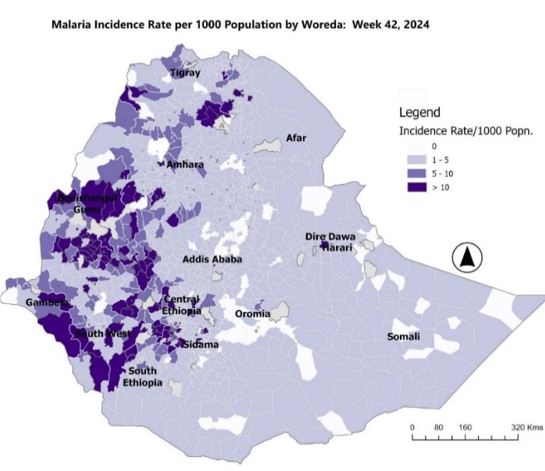
Throughout 2024, a malaria outbreak has intensified in the Federal Democratic Republic of Ethiopia, recently exceeding 7.3 million cases and 1,157 related fatalities (CFR 0.02%).
By contrast, 4.1 million malaria cases, including 527 fatalities, were reported last year.
Approximately 75% of Ethiopia's land mass is considered by the World Health Organization (WHO) endemic to malaria.
Historical data reveal significant malaria outbreaks in Ethiopia, such as the devastating 1958 epidemic, which affected approximately three million individuals, with 150,000 fatalities reported, covering a substantial portion of the highland area.
While located near Africa's malaria belt, Ethiopia is usually not listed as a leading outbreak zone by the WHO. In the African Region, the heaviest malaria burden is often reported in Burkina Faso, Cameroon, the Democratic Republic of the Congo, Ghana, Mali, Mozambique, Niger, Nigeria, Sudan, Uganda, and Tanzania.
As of October 31, 2024, the WHO wrote the national risk level for malaria in Ethiopia is high due to multiple factors, and the regional risk is moderate due to concurrent malaria and other vector-borne disease outbreaks in six neighboring countries: Djibouti, Eritrea, Kenya, Somalia, South Sudan, Sudan.
Based on the information available for this event, WHO does not recommend any general travel or trade restrictions for Ethiopia, reporting an upswing in international arrivals in 2024..
As of November 1, 2024, the U.S. CDC has not issued a Travel Health Advisory regarding Eithopia's malaria outbreak.
However, the CDC recommends that travelers going to some regions of Ethiopia take prescription medicine to prevent malaria.
While malaria and dengue vaccines are unavailable in the U.S., the CDC suggests prospective Ethiopian visitors speak with a travel vaccine expert at least one month before traveling abroad about polio and measles vaccination options.

As the world confronts dengue fever outbreaks in over 100 countries, many are launching vaccination campaigns to reduce the impact of this mosquito-transmitted disease.
And a Japan-based company is benefiting from increased vaccine sales.
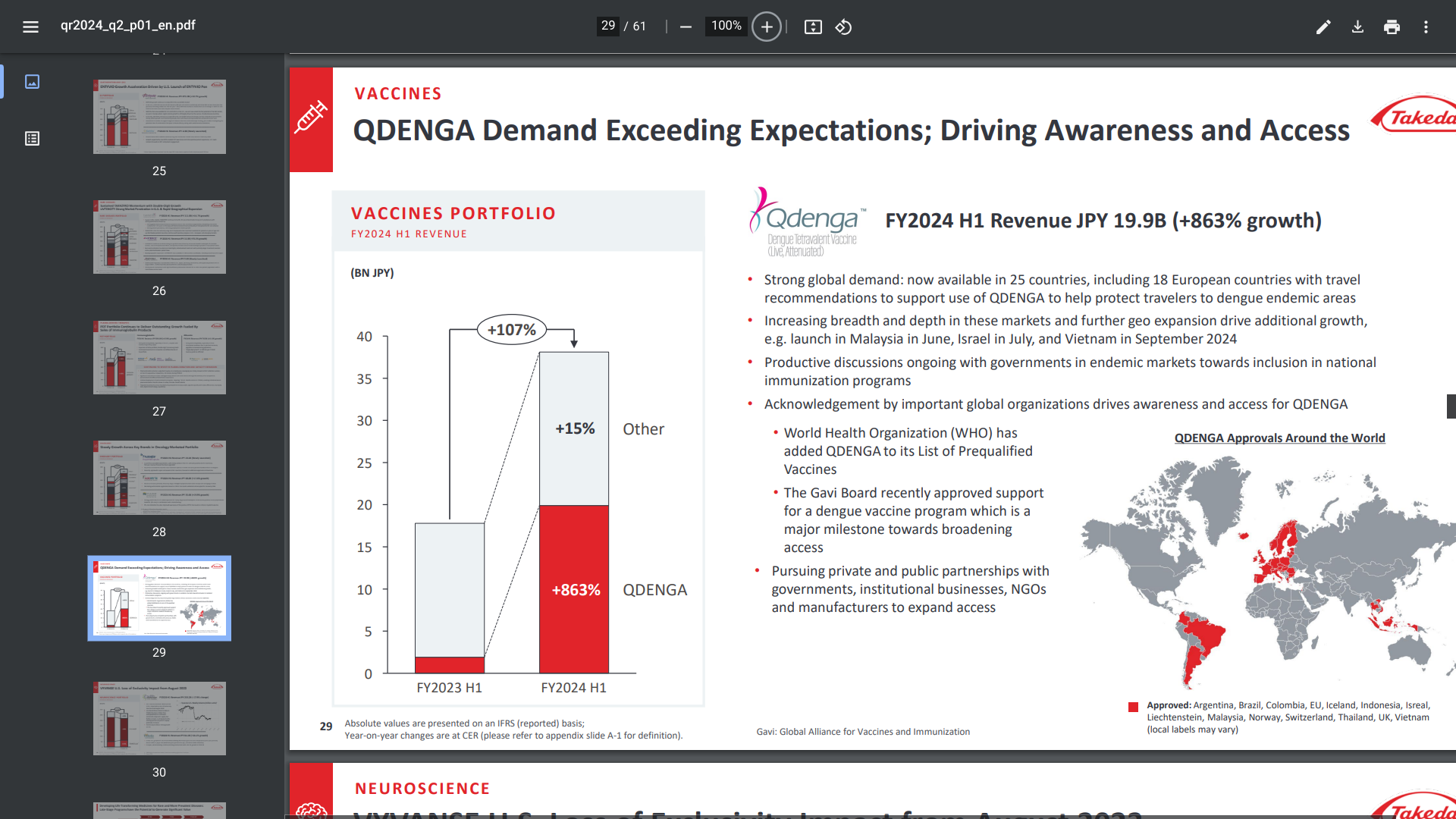
Takeda Pharmaceutical Company Limited today announced that its dengue vaccine QDENGA sales increased 863% in the FY2024 H1, reaching JPY 19.9 billion (~$124 million).
On October 31, 2024, Takeda's quarterly presentation revealed on slide #29, the following insights:
QDENGA is now available in 25 countries, including 18 European countries. Increasing breadth and depth in these markets and further expansion into Malaysia, Israel, and Vietnam in 2024.
Previously, the World Health Organization added QDENGA to its List of Prequalified Vaccines, and the Gavi Board recently approved support for a dengue vaccine program.
In the United States, where QDENGA is unavailable, the Centers for Disease Control and Prevention (CDC) has reported 6,819 travel-related and locally acquired dengue cases in 50 jurisdictions this year, led by California, Florida, New Jersey, New York, and Puerto Rico.
This CDC data indicates an 11% increase compared to 2023, when 6,164 dengue cases were reported.


Throughout 2024, the world has faced a record number of dengue virus outbreaks. To alert international travelers, the World Health Organization has classified dengue as a grade 3 emergency.
However, the continental United States has remained largely unaffected by this mosquito-borne outbreak.
In the U.S., Florida has reported local dengue cases for several years, while California had only two cases in 2023.
In recent months, Los Angeles has confirmed nine local dengue cases, and San Diego has reported two, bringing the total to eleven cases in California this year.
As reported by the San Diego HHS Agency on October 25, 2024, the second locally acquired dengue case in San Diego County has been confirmed in a Vista resident who became sick and was hospitalized. This person is not associated with the Escondido case.
Nationwide, the U.S. CDC has confirmed 6,494 travel and local-related cases in 50 states this year. Many of these local dengue cases (3,877) have been reported in Puerto Rico, with the San Juan region reporting about 1,400 cases.
And in the Region of the Americas, which includes the U.S., over 12 million cases and 7,289 related deaths in the Americas in 2024.
While Dengue is a vaccine-preventable disease, the U.S. is one of a limited number of countries not offering a vaccine at the end of 2024.