Search API
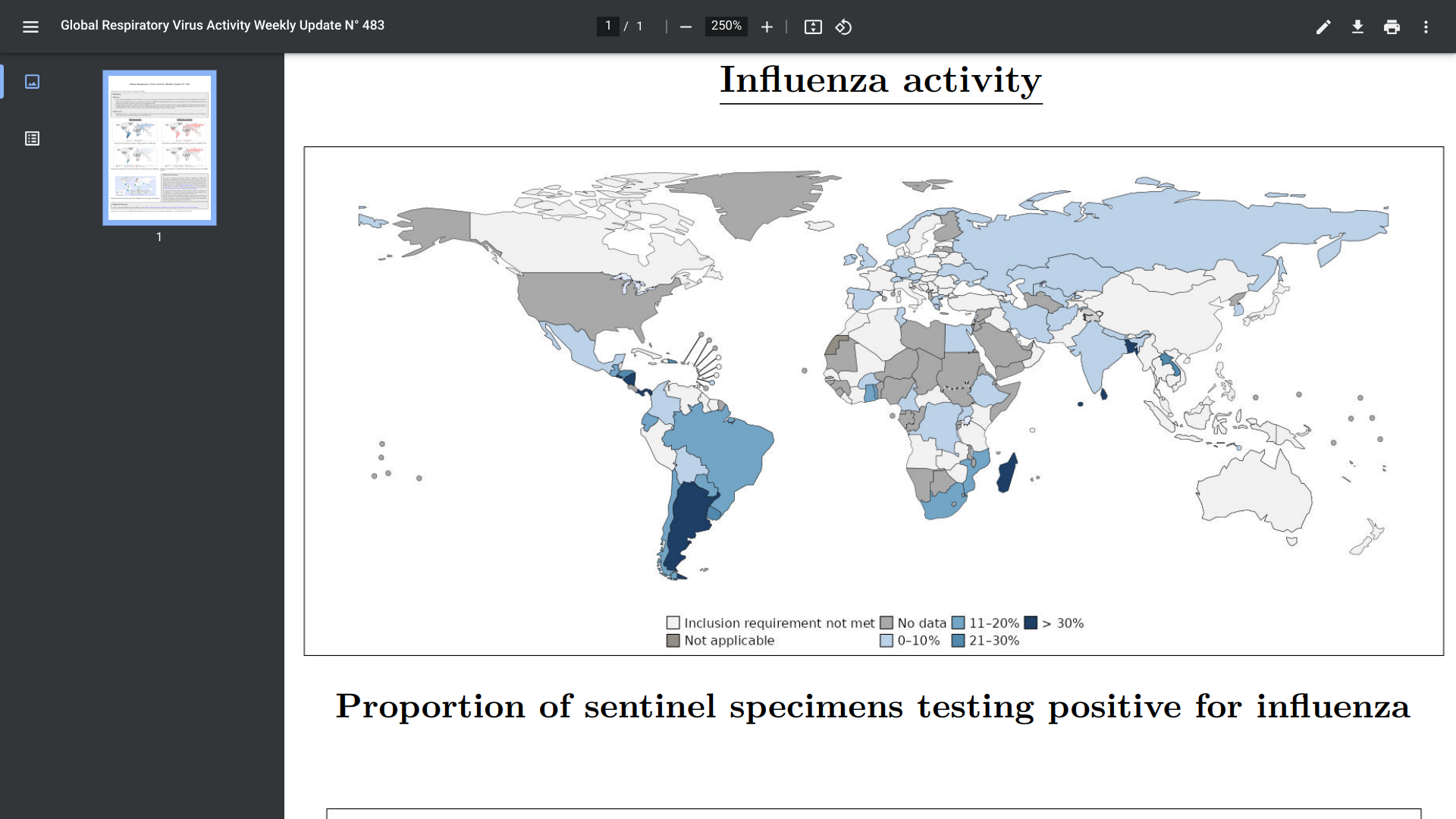
According to the World Health Organization (WHO) Influenza Update N° 483, elevated influenza activity was reported in countries in Central America and the Caribbean, Western Africa, Southern Asia, and South East Asia due to various virus types.
As of July 10, 2024, in the Southern Hemisphere, influenza activity continues to be elevated in South America and Oceania countries. There are indications that activity may have peaked in some South American and Southern African countries.
In the United States, influenza case reports for the 2024-2025 flu season are reduced.
However, flu shots for the new season have already been distributed to pharmacies in the U.S.

Biotechnology company Apriori Bio recently announced it was awarded $1.1 million from the Coalition for Epidemic Preparedness Innovations (CEPI) to advance its biology-informed artificial intelligence platform Octavia™, aimed at protecting humanity against rapidly evolving viruses by designing variant-resilient vaccines.
The new seed funding from CEPI will focus on pandemic influenza strain H3N2, which has previously affected pigs, birds, and humans.
The Octavia platform works by characterizing large libraries of viral variants on their ability to bind to cells in the human body and evade the immune response. Then, using machine learning, Octavia generates maps to identify the mutations that have the greatest ‘escape potential’ and could, therefore, pose the greatest threat.
Octavia builds and trains its algorithms using computational insights and experimental biological data. This includes studying viral evolutionary trees to identify the point at which viral variability is most likely to occur and exploring how mutations could affect each other.
These insights can guide the design and updating of new vaccines and existing vaccines so that they can protect against worrisome variants for years to come.
Lovisa Afzelius, Ph.D., MBA, Co-founder and CEO of Apriori, said in a press release on July 7, 2024, “We are honored to be recognized by a global leader in pandemic preparedness who shares our commitment to better protecting humanity from rapidly evolving viruses."
CEPI’s 2022-2026 plan, known as CEPI 2.0, will help the world make the scientific progress needed to respond to the next Disease X threat with a new vaccine in just 100 days. This goal is known as the 100 Days Mission.


Colossal today announced that the first elephant in captivity at the Houston Zoo has been administered an experimental herpesvirus mRNA vaccine. The Houston Zoo approved the vaccine and has inoculated Tess, a 40-year-old Asian elephant.
On July 9, 2024, Colossal stated the elephant endotheliotropic herpesvirus (EEHV) is the number one killer of Asian elephant calves living under managed care in North America and Europe and significantly impacts free-ranging populations of Asian elephants as well.
Recent EEHV-related deaths in several African elephants in the U.S. have raised concerns about EEHV in this elephant species.
Following encouraging results from the initial vaccine trials, the mRNA vaccine will be offered to more facilities, especially those with vulnerable young elephants.
“Colossal supported our efforts to work on an mRNA solution approach,” shared Dr. Paul Ling, Professor at the Department of Microbiology and Virology at Baylor College of Medicine, in a press release.
“It quickly became evident that the mRNA solution was going to be feasible, so we prioritized implementing that approach. We are much further along today than we would have been without Colossal’s scientific support, research teams, and funding.”
In the next three to five years, Dr. Ling hopes this vaccine will be applied to the broad population of elephants under human care worldwide. Following that, the team would look to applications with animals in the wild.
This represents a massive step forward for the protection of elephants globally and a huge step forward for science.
According to the Houston Zoo, Tess, mother to Tucker (19), Tupelo (13), Tilly (6), and Teddy (3) and grandmother to Winnie (3), is currently doing well post-vaccination.
Upon the successful outcome of this first vaccination, the Houston Zoo plans to vaccinate additional animals under its care.
As of July 9, 2024, the U.S. FDA has not approved a herpes vaccine for humans.


The World Health Organization (WHO) Disease Outbreak News confirmed the mpox outbreak in South Africa has expanded.
The sudden appearance of unlinked mpox cases in South Africa without a history of international travel, the high HIV prevalence among confirmed cases, and the high case-fatality ratio suggest that community transmission of the mpox virus is underway
As of July 9, 2024, 20 confirmed mpox cases, with three related fatalities in Gauteng, Western Cape, and KwaZulu-Natalhave provinces, have been reported since May 2024.
These mpox cases are South Africa's first since 2022, when five cases were reported, none fatal.
The WHO stated, 'Discussions are underway regarding options for vaccine procurement.'
Currently, two mpox vaccines are being deployed in other African countries.

CSL Seqirus today announced that it has commenced shipping its differentiated portfolio of influenza vaccines. This year, the company's influenza vaccines are being produced as trivalent influenza vaccine formulations, in compliance with the U.S. Food and Drug Administration's directive in 2024 to remove the B/Yamagata strain.
For the 2024-2025 influenza vaccine portfolio, CSL Seqirus is the leading manufacturer offering a differentiated influenza vaccine option approved for use in people six months and older.
For example, FLUCELVAX® is the first and only cell-based influenza vaccine indicated for use in people six months and older.
"Influenza continues to pose a significant threat, as evidenced by recent flu seasons," said Dr. Gregg Sylvester, Chief Health Officer, CSL Seqirus, in a press release on July 9, 2024.
"As we begin distributing influenza vaccines to healthcare providers throughout the U.S., it is imperative that we work to maintain high vaccination rates this season to help reduce the burden of influenza-related illnesses and the risk of severe outcomes."
CSL Seqirus is part of CSL, a global leader in the protection of public health and one of the largest influenza vaccine providers in the world.

A virus-like particle (VLP) based vaccine candidate in development to prevent moderate-to-severe acute gastroenteritis (AGE) in infants caused by norovirus infection is being discontinued.
This is unfortunate news since the health burden of norovirus falls disproportionately on young children and older adults.
HilleVax, Inc. today announced topline data results from NEST-IN1, a Phase 2b, randomized, double-blind, placebo-controlled clinical trial to evaluate the efficacy, safety, and immunogenicity of the HIL-214 vaccine candidate in infants of approximately five months of age at the time of initial vaccination at sites in the United States and Latin America.
In the NEST-IN1 study, there were 51 primary endpoint events, with 25 in the vaccine arm (n=1,425) and 26 in the placebo arm (n=1,399), resulting in a vaccine efficacy of 5% (95% confidence interval; -64%, 45%).
The study did not meet its primary efficacy endpoint against moderate or severe AGE events due to GI.1 or GII.4 norovirus genotypes. And no clinical benefit was observed across secondary endpoints. The company plans to discontinue further development of HIL-214 in infants.
HIL-214 did exhibit a safety and immunogenicity profile consistent with what was observed in the prespecified analysis of the first 200 subjects in NEST-IN1 and previously reported studies.
“We are disappointed that the NEST-IN1 study did not meet its primary efficacy endpoint,” said Rob Hershberg, MD, PhD, Chairman and Chief Executive Officer of HilleVax, in a press release on July 8, 2024.
“While HIL-214 previously showed clinical benefit in adults, NEST-IN1 was the first efficacy study conducted in infants for a norovirus vaccine candidate. We believe the efficacy in the infant setting may have been impacted by the appearance of multiple emerging GII.4 strains in this trial.”
The company stated it is exploring the potential for continued development of HIL-214 and HIL-216 in adults, HilleVax’s Phase 1 ready vaccine candidate.
Currently, there are no U.S. FDA-approved norovirus vaccines.
Globally, norovirus is estimated to result in approximately 700 million cases of AGE and 200,000 deaths per year, resulting in over $4 billion in direct health system costs and $60 billion in societal costs per year.
The U.S. CDC publishes information about gastrointestinal illness outbreaks on cruise ships in the Vessel Sanitation Program during 2024, including details and actions taken in response.