Search API

0 min read

Moderna, Inc., today announced that the U.S. Food and Drug Administration (FDA) has notified it that due to administrative constraints, the agency does not expect to complete its review of the Biologics License Application for mRNA-1345, Moderna's investigational respiratory syncytial virus (RSV) vaccine, by the previously communicated Prescription Drug User Fee Act date of May 12, 2024.

The FDA informed Moderna on May 10, 2024, that it is working to conclude its review of mRNA-1345 by the end of May 2024.

The FDA has not informed Moderna of any issues related to vaccine safety, efficacy, or quality that would prevent the approval of mRNA-1345.

Image: 
Image Caption: 
Pixabay 2024
Live Blog Update Author: 
Location Tags: 
Include in VBT newsletter: 
0 min read

The U.S. CDC reported today that seasonal influenza activity continues to decline nationally, with outpatient respiratory illness stable and below baseline for the fifth consecutive week.

As of Week #18, the CDC says that flu viruses are among the several contributing factors to respiratory disease activity. To help people understand their health risks, the CDC provides updated, integrated information about influenza, RSV, and other disease activity every week.

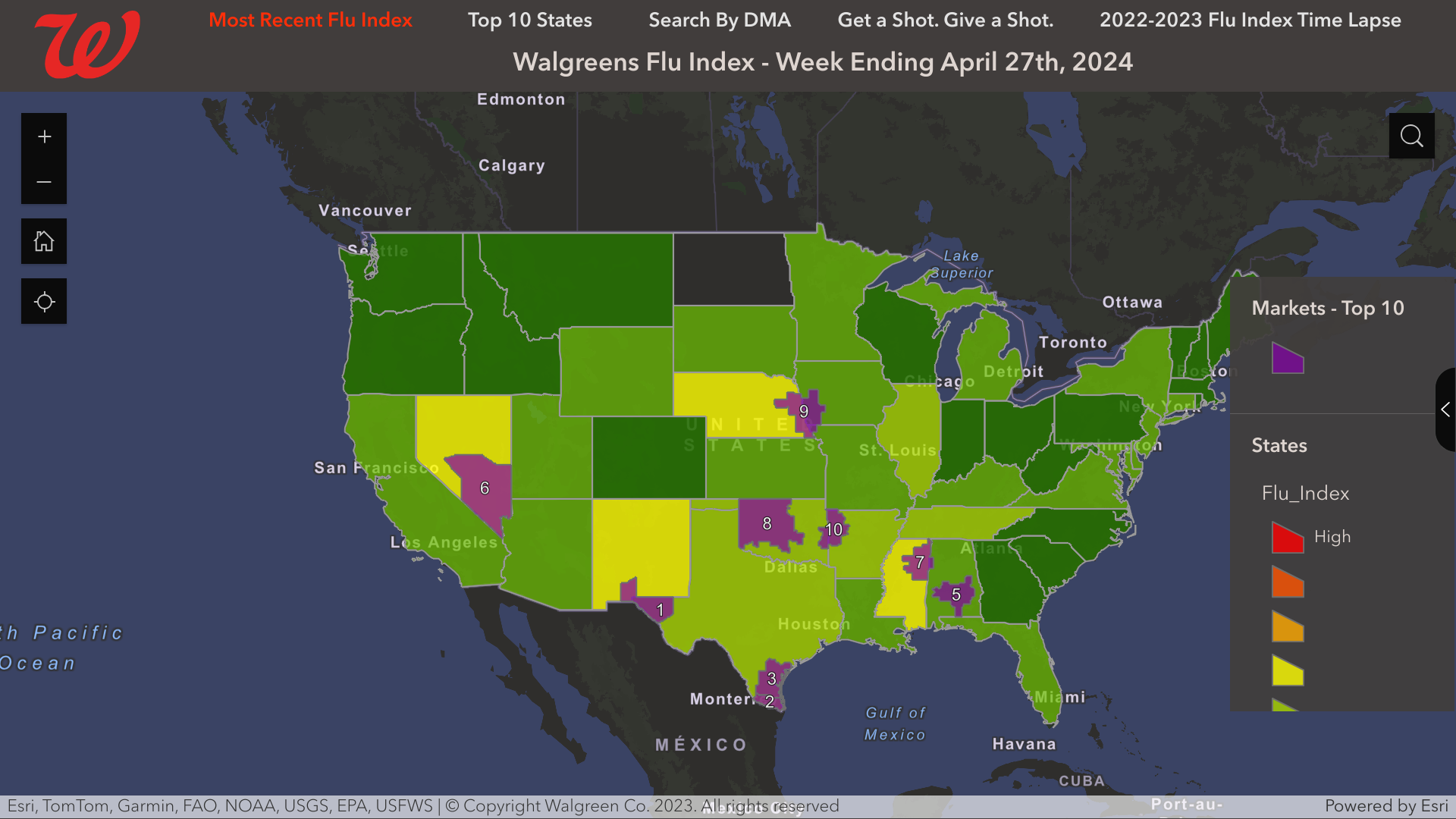
From a local perspective, the Walgreens Flu Index recently identified three Texas cities that led the USA with influenza activity in late April 2024.

These cities are:

  1. El Paso, Texas (Las Cruces, N.M.
  2. Harlingen-Weslaco-Brownsville-McAllen, Texas
  3. Corpus Christi, Texas

The CDC also disclosed that about 63 million flu shots have been administered at pharmacies and physician offices this flu season, which indicates about 6% fewer flu shots administered than last season.

These vaccines remain available at most pharmacies in the U.S.

Vaccine Treats: 
Image: 
Image Caption: 
Walgreen Flu Index map April 27, 2024
Live Blog Update Author: 
Location Tags: 
Include in VBT newsletter: 
vaccine
Protein based COVID-19 vaccine producer Novavax partners with Sanofi
0 min read

The American Academy of Pediatrics journal recently confirmed data from the Vaccine Adverse Event Reporting System (VAERS) revealed over two dozen young children were incorrectly administered an adult RSV vaccine.

As reported in a Research Brief on May 9, 2024, these children were under the age of two between August 2023 and March 2024.

In January 2024, the Centers for Disease Control and Prevention (CDC) announced vaccine administration errors are known to occur.

Since the approval of RSV vaccines and the launch of a second-generation monoclonal antibody, VAERS has received reports of the Pfizer (Abrysvo) or GSK (Arexvy) vaccines being administered in error to children.

Additionally, the CDC and U.S. FDA have received reports of Arexvy being administered in error to pregnant women. 

According to the U.S. CDC, no special monitoring is needed when an adult RSV vaccine is administered to children. However, if eligible, children who receive an RSV vaccine in error should receive Beyfortus™ to prevent severe RSV disease.

Beyfortus (Nirsevimab) is a long-acting monoclonal antibody that prevents severe RSV disease. As of May 10, 2024, Beyfortus is reported to be about 90% (95% CI = 75%–96%) protective against RSV-associated hospitalization in infants in their first RSV season. 

The CDC says that although both monoclonal antibodies and vaccines provide protection, how they deliver protection differs.

Image: 
Image Caption: 
by Binay Sahoo
Live Blog Update Author: 
Location Tags: 
Include in VBT newsletter: 
0 min read

The World Health Organization (WHO) today announced three human cases, including one death, of Middle East respiratory syndrome coronavirus (MERS-CoV) by the Ministry of Health of the Kingdom of Saudi Arabia (KSA).

According to the WHO's Disease Outbreak News on May 8, 2024, all three cases were middle-aged males with underlying health conditions.

The three cases are epidemiologically linked to exposures in a Riyadh healthcare facility, although investigations are ongoing to verify this and understand the transmission route.

In 2024, a total of four cases and two deaths have been reported from the KSA.

MERS is a viral respiratory infection caused by the MERS-CoV. Humans are infected with MERS-CoV from direct or indirect contact with dromedary camels, the virus's natural host and zoonotic source.

So far, non-sustained human-to-human transmission has occurred among close contacts and in healthcare settings. However, the WHO reports limited human-to-human transmission outside of healthcare settings.

Since 2012, when the first MERS-CoV case was reported in KSA, 2,613 MERS-CoV cases and 941 deaths (36%) have been reported from 27 countries in all six WHO regions.

Fortunately, no MERS-CoV cases have been reported from countries outside the Middle East since 2019.

The notification of the new cases does not change WHO's overall risk assessment, which remains moderate at both the global and regional levels.

As of May 9, 2024, no approved MERS vaccines are available.

However, in late 2023, Barinthus Biotherapeutics plc, the Coalition for Epidemic Preparedness Innovations, and the University of Oxford collaborated on fast-tracking the development of the VTP-500 vaccine candidate.

This $34.8 million project intends to take this MERS vaccine through Phase II clinical trials.

Vaccine Treats: 
Image: 
Image Caption: 
by Sunè Theron
Live Blog Update Author: 
Location Tags: 
Vaccine: 
Include in VBT newsletter: 
Dengue vaccine
Dengue vaccines are approved in May 2024
0 min read

The U.S. Centers for Disease Control and Prevention (CDC) today confirmed that imported malaria in three U.S. southern border jurisdictions increased in 2023, particularly among new arrivals with recent complex transit through at least one country with endemic malaria. 

The median travel duration was 29 days, and 73% reported traversing land borders.

On May 9, 2024, the CDC's Notes from the Field revealed that during 2023, 68 imported malaria cases were identified in Pima, Arizona (18), San Diego, California (27), and El Paso, Texas (23).

According to this Morbidity and Mortality Weekly Report, his data compares with 28 cases in 2022 (three in Pima, 12 in San Diego, and 13 in El Paso).

Overall, 63 (91%) patients with malaria in 2023 were hospitalized; no deaths were reported. Severe malaria was more common among other newly arrived migrants (37%) than among U.S. residents (7%).

These new arrivals were non–U.S.-born persons who had arrived in the United States within the preceding six months.

This CDC report is in addition to May 8, 2024, when the CDC reported ten Plasmodium vivax malaria cases in Los Angeles, California.

Seperately the states of Florida and Texas have reported imported malaria cases in 2024, 2023, and 2022. 

Infected people who meet the criteria for uncomplicated malaria are generally treated with either hydroxychloroquine, chloroquine, or atovaquone/proguanil, followed by anti-relapse treatment with primaquine.

While malaria is now a vaccine-preventable disease, the two approved vaccines (Mosquirix™, R21/Matrix-M™)   are not currently offered in the U.S.

Vaccine Treats: 
Image: 
Image Caption: 
by Lynn Greyling
Live Blog Update Author: 
Location Tags: 
Include in VBT newsletter: 

Herpes Vaccine Clinical Trials

Herpes Vaccine Candidate Clinical Trials 2025

After several years of preclinical development, multiple herpes vaccine candidates advanced to phase 2 clinical trials in 2025. These herpes clinical trials required additional study participants from various states.

And when phase 3 clinical trials commence, more people will be recruited for each study. Furthermore, some of these studies offer compensation for those who engage.

To learn more about herpes clinical trials, please visit this webpage.

Herpes Vaccine Candidates

An updated listing of herpes vaccine candidates is posted on this webpage.

Herpes Testing

Herpes tests are available on this PVax webpage.

1 min read
Last Reviewed: 
Saturday, August 2, 2025 - 05:30
Description: 
Herpes vaccine candidate clinical trials are active in 2025
Condition: 
0 min read

Dynavax Technologies Corporation today announced that HEPLISAV-B® vaccine net product revenue grew 10% year-over-year to approximately $48 million in the first quarter of 2024.

HEPLISAV-B is the first and only adult hepatitis B vaccine approved in the U.S., the European Union, and Great Britain to enable series completion with only two doses in one month.

In 2024, HEPLISAV-B's total estimated market share in the U.S. increased to approximately 41%, and its estimated market share in the retail pharmacy segment increased to approximately 55%.

"The U.S. adult hepatitis B vaccine opportunity remains significant with over 130 million patients eligible, one of the largest addressable patient populations in the U.S., and the vast majority remaining unvaccinated," said Ryan Spencer, Chief Executive Officer of Dynavax in a press release on May 8, 2024.

Hepatitis B is a viral infection that affects the liver and can cause acute or chronic disease.

Driven by the U.S. CDC's Advisory Committee of Immunization Practices' universal recommendation for adult hepatitis B vaccination, the hepatitis B vaccine market continues to expand in the U.S. Dynavax believes the U.S. market has the potential to grow to over $800 million by 2027, with HEPLISAV-B well-positioned to achieve a majority market share.

A supplemental Biologic License Application for HEPLISAV-B vaccination of adults on hemodialysis is currently under review by the U.S. FDA, with a Prescription Drug User Fee Act action date planned for May 13, 2024.

Vaccine Treats: 
Image: 
Image Caption: 
Medline plus 2024
Live Blog Update Author: 
Location Tags: 
Include in VBT newsletter: 
rabies vaccine
Pika Rabies vaccine candidate targets one-week human rabies regimen