Search API
Measles outbreaks increased by about 80% during 2022, and disease experts warned of increasing outbreaks in 2023.
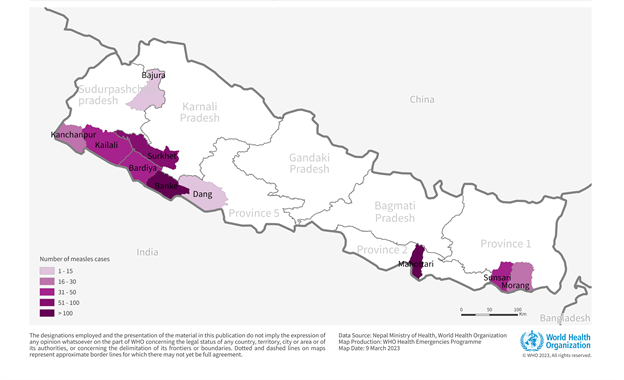
For example, the World Health Organization (WHO) recently announced an outbreak of measles was confirmed in Nepalgunj sub-metropolitan city (SMC) in Banke district, Nepal, following a cluster of fever and rash cases.
Following the confirmation and through active case search as of March 14, 2023, the index case was identified, with the onset of symptoms on November 24, 2022. Between November 24, 2022, and March 10, 2023, 690 measles cases, including one associated death (case fatality ratio: 0.14 %), were reported from seven districts in western Nepal and three in eastern Nepal (Terai ecological region).
The majority of the cases (n=591; 86%) have been reported in children aged less than 15 years.
While measles is endemic in Nepal and is reported every year, the magnitude and extent of the current outbreak are unusually high compared to the previous years.
Only sporadic isolated measles cases had occurred since 2004 when a significant outbreak of over 12,000 cases was reported.
The WHO says the risk of the spread of measles is assessed as high at the national level and moderate at the regional level.
Measles is a vaccine-preventable disease, with various vaccines offered at clinics and community pharmacies in the U.S. during 2023.
The U.S. Centers for Disease Control and Prevention (CDC) Technical Report issued on March 17, 2023, stated that despite the geographic spread of highly pathogenic avian influenza (HPAI) A(H5N1) viruses, only a small number of 'bird flu' cases in people have been identified.
The CDC stated all reported human cases since 2022 have been associated with poultry exposures.
And no bird flu cases of human-to-human transmission have been identified, says the CDC.
However, because of the potential for influenza viruses to evolve rapidly, continued sporadic human infections are anticipated.
To date, more than 6,300 people in 52 jurisdictions have been monitored since 2022, and only one human case in Colorado has been identified.
However, there has been an upsurge in various mammals dying from bird flu in Canada and the U.S. during 2023.
The CDC presented some good news regarding bird flu vaccines.
An H5 candidate vaccine virus (CVV) produced by CDC is nearly identical or, in many samples, identical to the hemagglutinin (HA) protein of recently detected clade 2.3.4.4b HPAI A(H5N1) viruses in birds and mammals and could be used to produce a vaccine for people.
This H5 CVV is available and has been shared with vaccine manufacturers.
One manufacturer, CSL Seqirus Inc., has already produced a U.S. FDA-approved vaccine, Audenz™.
Audenz is a monovalent, adjuvanted, cell-based inactivated influenza (H5N1) subunit vaccine designed to protect people from bird flu.

The U.S. Centers for Disease Control and Prevention (CDC) today reported two insightful data points. First, as of March 17, 2023, the CDC's national outpatient respiratory illness data is now below baseline, as are six of 10 HHS regions.
This data indicates the 2022-2023 flu season in the U.S. is coming to an early close.
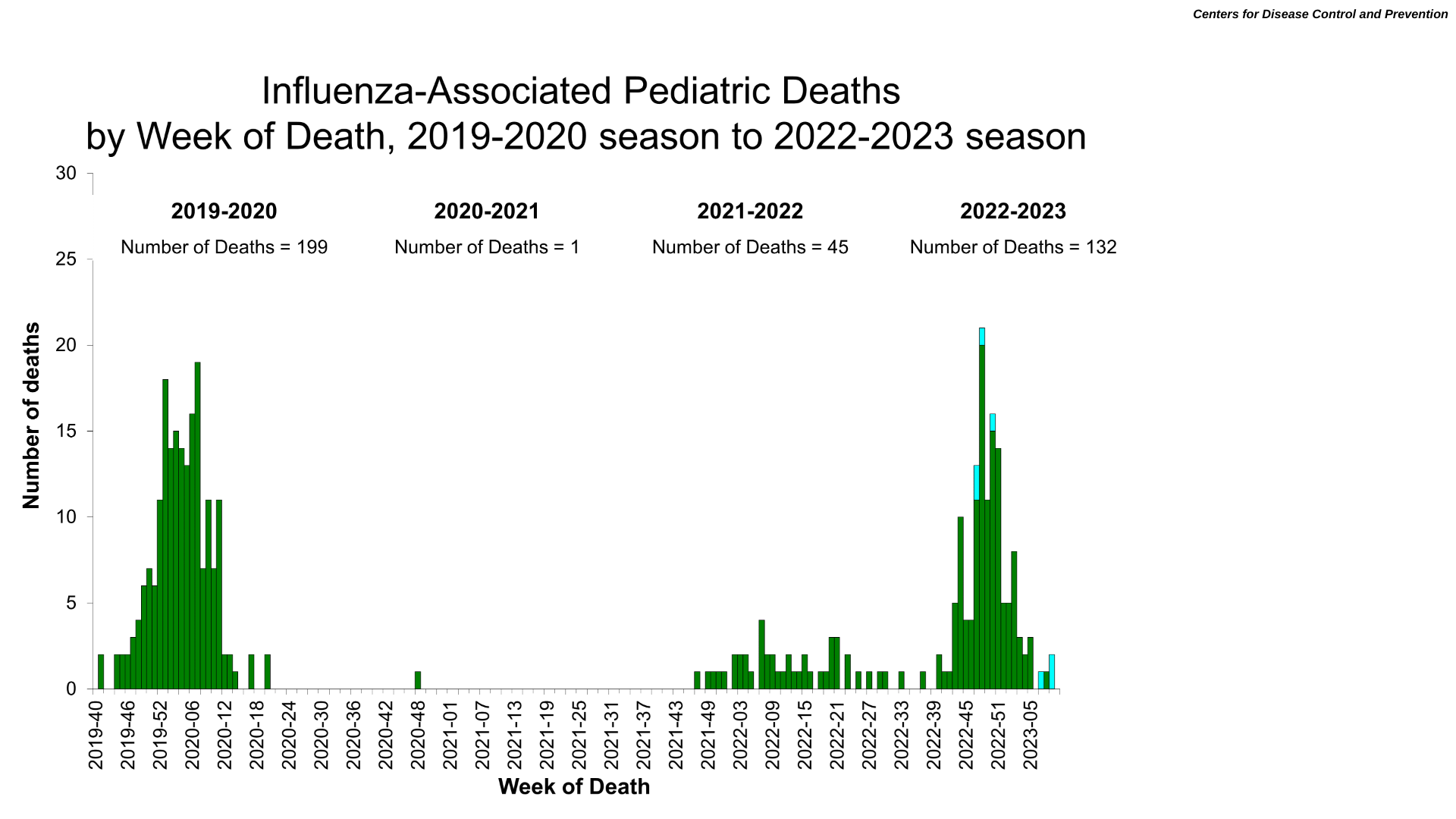
However, as of week #10 data, seven additional influenza-associated pediatric deaths occurred.
The deaths occurred between week #47 of 2022 and week #9 of 2023.
All seven deaths were associated with influenza A viruses. Four of the influenza A viruses had subtyping performed; one was an A(H1N1) virus, and three were A(H3) viruses.
This CDC update means there have been 132 influenza-associated pediatric deaths this flu season, the most significant amount since 2019.
The CDC continues to remind everyone that flu shots remain available at most health clinics and pharmacies in the U.S.
GSK plc recently announced positive results from a phase 3 clinical trial evaluating its MenABCWY combination vaccine candidate, administered as two doses given six months apart in healthy individuals aged 10-25 years.
GSK's MenABCWY vaccine candidate combines the antigenic components of its licensed meningococcal vaccines, Bexsero (MenB) and Menveo (MenACWY).
All primary endpoints were met, including the non-inferiority of the vaccine candidate for all five Neisseria meningitides serogroups (A, B, C, W, and Y) compared to licensed meningococcal vaccines Bexsero and Menveo in terms of an immune response.
In addition, the vaccine candidate was well tolerated, with a safety profile consistent with Bexsero and Menveo.
Tony Wood, Chief Scientific Officer at GSK, commented in a press release on march 14, 2023, "These statistically significant phase III data are a very encouraging step toward reducing the incidence of meningococcal disease."
"In the U.S., routine use of a 5-in-1 meningococcal vaccine with a two-dose regimen in adolescents at 16 to 18 years of age, just before this disease's incidence peak, could drive significant public health impact."
Invasive meningococcal disease (IMD), a significant cause of meningitis and septicemia, is an uncommon but serious illness that can cause life-threatening complications or even death, typically amongst previously healthy children and adolescents.
Five Neisseria meningitides serogroups (A, B, C, W, and Y) account for nearly all IMD cases worldwide.
Among those contracting meningococcal diseases, one in ten will die, sometimes in as little as 24 hours, despite treatment.
As yet, no licensed combination vaccine offers protection against these serogroups in a single vaccine.
Currently, in the U.S., two separate vaccines needing four injections are required to protect against all five serogroups.
This immunization regimen and low awareness of the disease can lead to sub-optimal immunization coverage rates, particularly for MenB, with an estimated coverage of only about 31% of adolescents in the U.S.
GSK works closely with regulators to review the complete phase III data set, including the supplemental Biologics License Application for Bexsero.
This clinical trial was the confirmatory trial for Bexsero and the phase III trial for MenABCWY.
Detailed results from this phase III trial will be presented in a peer-reviewed publication and at upcoming scientific meetings.


The Government of Canada today confirmed its' main priority continues to be protecting the health and safety of Canadians. Throughout the recent pandemic, decisive actions taken empowered Canada to scale up domestic biomanufacturing capacity, which had been in decline for over 40 years.
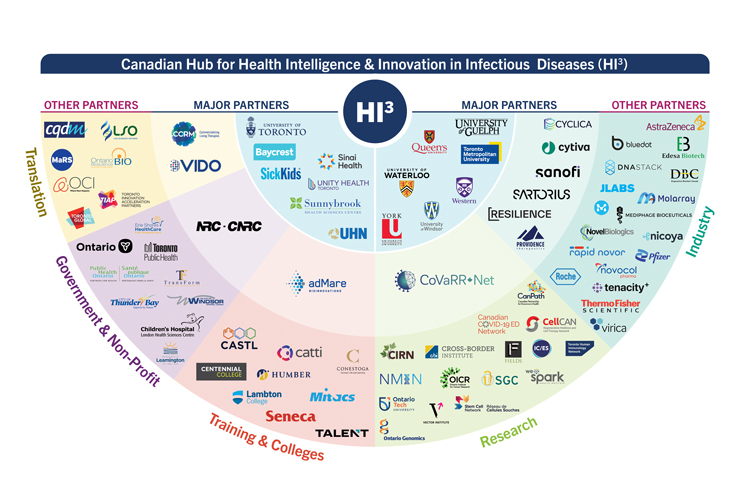
On March 14, 2023, Adam van Koeverden, Parliamentary Secretary to the Minister of Health and to the Minister of Sport, highlighted in a press release an investment of $2 million to create the Canadian Hub for Health Intelligence & Innovation in Infectious Diseases (HI3).
This support is part of a $10 million investment announced on March 2, 2023, for creating five research hubs as part of Stage 1 of the integrated Canada Biomedical Research Fund and Biosciences Research Infrastructure Fund competition.
The University of Toronto (UofT) leads the Canadian Hub for Health Intelligence & Innovation in Infectious Diseases.
The HI3 hub is led by co-directors Jen Gommerman and Scott Gray-Owen, professors of immunology and molecular genetics, respectively, in the Temerty Faculty of Medicine at U of T.
It will focus on advancing the concept of "personalized and precise medicine" to influence the development of vaccines, therapeutics, and other public health interventions.
The U.S. Food and Drug Administration (FDA) presented some good news last week regarding influenza vaccines. The FDA confirmed this season's influenza vaccination provided substantial protection against inpatient, emergency department, and outpatient illnesses among all ages.
On March 7, 2023, Lisa Grohskopf, MD, MPH, with the U.S. Centers for Disease Control and Prevention (CDC), presented to the FDA's Vaccines and Related Biological Products Advisory Committee updated vaccine effectiveness (VE) information through January 2023.
Dr. Grohskopf's presentation highlighted influenza vaccination significantly reduced disease by the following:
- 39% (95%CI: 31, 45) against adult hospitalizations,
- 44% (95%CI: 41, 47) against adult ED or UC visits, and
- VE was observed across age groups and immunocompromised.
Furthermore, this flu season's estimates are higher than VE estimates against hospitalization (25%) and ED or UC visits (25%) from the 2021–22 season.
As of March 15, 2023, the CDC says various flu shots remain available at most clinics and pharmacies in the U.S., and late-season vaccinations are advised for certain at-risk people.
Over 173 million influenza vaccines have already been distributed this flu season.


A recent Lancet Lancet Infectious Diseases analysis concluded that a single dose of Modified Vaccinia Ankara (MVA-BN, Jynneos®) vaccine was very protective against mpox.
Published on March 13, 2023, Dimie Ogoina, with Niger Delta University and colleagues, wrote the 78% vaccine effectiveness reported suggests that a single dose of Jynneos is considered protective against symptomatic mpox only after 13 days post-vaccination.
Furthermore, this analysis and other studies suggest that using a single dose of Bavarian Nordic's Jynneos as pre-exposure prophylaxis is preferable to post-exposure prophylaxis to guarantee protection against symptomatic mpox.
And because people living with HIV have been shown to have a higher risk of breakthrough COVID-19 infections post-vaccination, identifying four of eight breakthrough mpox infections among people living with HIV is noteworthy.
However, the Jynneos vaccine has previously been shown to be immunogenic among adults with a history of AIDS.
Since there are no approved HIV vaccines, co-administration data is unavailable.
Additional Mpox outbreak news is posted at MpoxToday.