Search API
CureVac N.V. today announced the start of the Phase 1 part of a combined Phase 1/2 clinical trial of an investigational influenza A (H5N1) pre-pandemic vaccine candidate developed in collaboration with GSK.
In the initial Phase 1 dose-escalation part of the study, up to five dose levels will be assessed compared to a placebo control. The study will be conducted in the United States.
The monovalent vaccine candidate is based on CureVac's proprietary second-generation messenger ribonucleic acid (mRNA) backbone and encodes an influenza A H5-antigen.
Dr. Myriam Mendila, CureVac's Chief Development Officer, commented in a press release on April 24, 2024, "This clinical milestone, in collaboration with GSK, expands the application of our mRNA technology into an additional indication in infectious diseases and addresses the need to be prepared for potential future pandemics."
The H5N1 avian influenza virus is considered a potential pandemic threat. It is known to sporadically cross-species from its original bird host to other animal hosts, such as bears, cows, foxes, and humans worldwide.
The combined Phase 1/2 study will evaluate the safety, reactogenicity, and immunogenicity of an investigational influenza A (H5N1) pre-pandemic vaccine candidate in healthy younger and older adults.
The broad CureVac-GSK infectious disease collaboration was first announced in July 2020.
As of April 2024, the U.S. government has approved a bird flu vaccine (Audenz) and invested hundreds of millions in preparing avian influenza vaccine candidates.

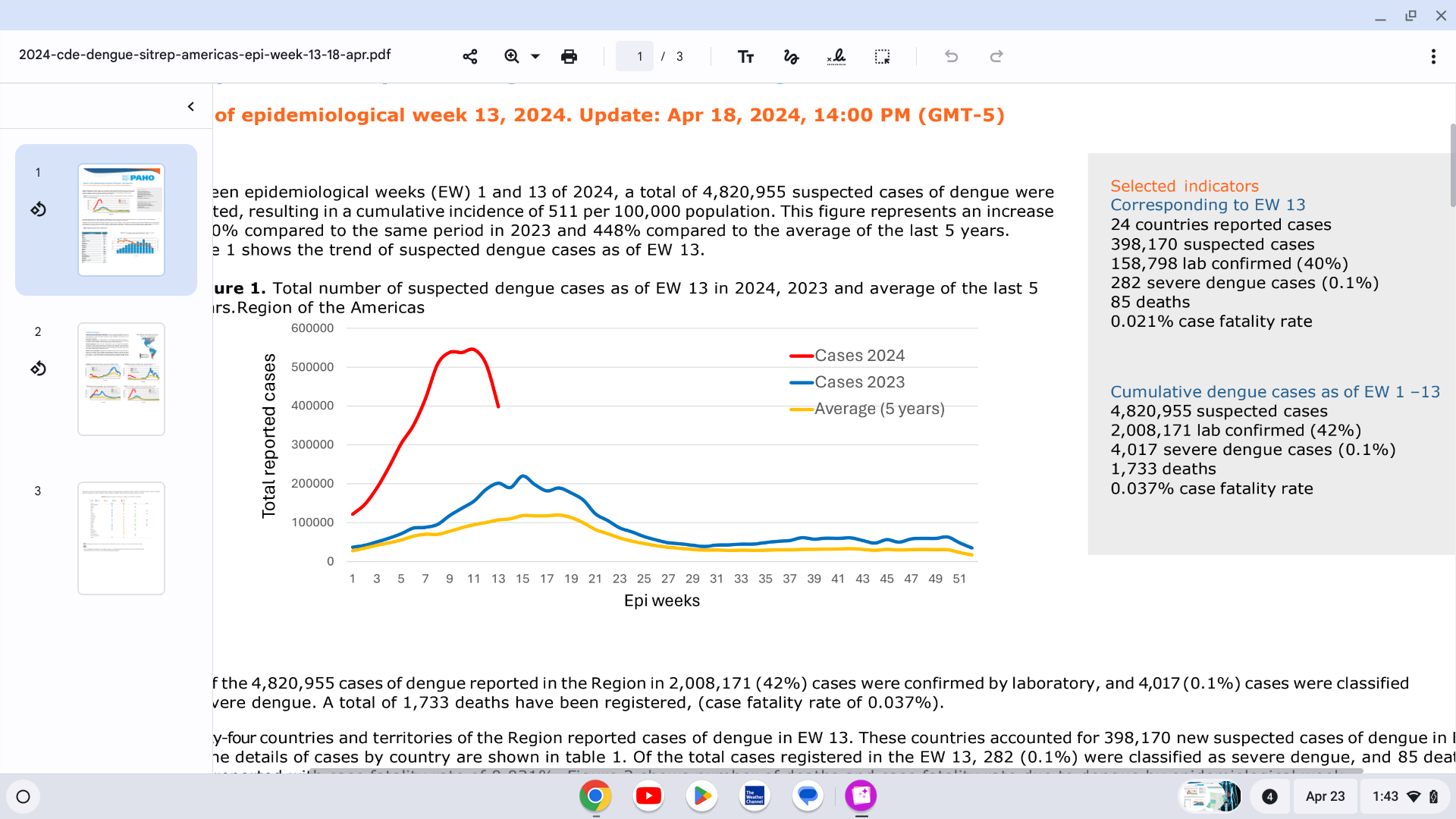
Since the first dengue-like epidemic was suspected in 1635 in the Caribbean Islands, this mosquito-transmitted disease has impacted the health of millions of people throughout the Region of the Americas.
According to new data, the year 2024 may set an all-time record.
The Pan American Health Organization (PAHO) recently issued Situation Report No. 14 confirming that 4,820,955 suspected cases of Dengue (an increase
of 260% from 2023) and 1,733 deaths have been registered as of mid-April 2024.
As of April 23, 2024, Brazil has reported the most Dengue cases this year.
To alert international travelers, the U.S. Centers for Disease Control and Prevention (CDC) reissued its Level 1 Travel Health Advisory for the Americas on April 18, 2024. The countries listed have reported higher-than-usual dengue cases.
The CDC says travelers to these Caribbean, Central, and South American countries may be at increased risk.
Within the U.S., the CDC reported that 37 jurisdictions have reported 929 dengue cases as of April 2024.
The unfortunate leader is Puerto Rico, which has 644 dengue cases, followed by the state of Florida, which has 106 travel-associated cases and five locally acquired dengue cases this year.
From a prevention perspective, two dengue vaccines have been approved. To learn about vaccination options, the CDC says travelers should speak with a vaccine advisor at least one month before traveling abroad.
As of April 23, 2024, travel vaccines are offered at specialty clinics and certified pharmacies in the U.S.

ImmunityBio, Inc. today announced that the U.S. Food and Drug Administration (FDA) had approved ANKTIVA® (N-803) plus Bacillus Calmette-Guérin (BCG) vaccine for the treatment of patients with BCG-unresponsive non-muscle invasive bladder cancer (NMIBC) with carcinoma in situ (CIS), with or without papillary tumors.
This treatment is essential as bladder cancer is the 10th most commonly diagnosed cancer globally, and the American Cancer Society estimates there will be 83,190 new cases and 16,840 deaths from bladder cancer in the U.S. in 2024.
"The FDA's approval of ANKTIVA marks our launch of a next-generation immunotherapy beyond checkpoint inhibitors," said Patrick Soon-Shiong, M.D., Executive Chairman and Global Chief Scientific and Medical Officer at ImmunityBio, in a press release on April 22, 2024.
"ANKTIVA not only proliferates and activates the patient's own NK cells and CD8+ killer T cells, but also activates CD4+ T helper cells, thus enhancing the proliferation of memory killer T cells.
ANKTIVA is a novel IL-15 superagonist complex consisting of an IL-15 mutant (IL-15N72D) fused with an IL-15 receptor alpha, which binds with high affinity to IL-15 receptors on NK, CD4, and CD8 T cells.
ANKTIVA is expected to be available in the United States by mid-May 2024, as well as ImmunityBio's Patient Assistance Program.
Merck's TICE® BCG vaccine is used in this therapy.

The Florida Department of Health published Arbovirus Surveillance Update #15, which discloses various mosquito-borne diseases reported this year.
As of April 13, 2024, countries in southern Florida confirmed these mosquito-transmitted diseases:
- Chikungunya - Three cases of chikungunya that began in 2024 have been reported in individuals with a travel history to Brazil, and four cases were confirmed in 2023.
- Dengue Fever - In 2024, 106 travel-associated dengue cases have been reported, mainly by visitors from Cuba. In 2023, 609 travel-associated dengue cases were reported, primarily in people arriving from Brazil and Cuba. Five cases of locally acquired dengue were reported from Miami-Dade (4) and Pasco counties in 2024.
- Malaria - In 2024, nineteen cases of malaria with onset in 2024 have been reported in individuals with a travel history to malaria-endemic areas in Africa. In 2023, 78 malaria cases were reported.
To learn where these diseases are spreading, the U.S. CDC issued Travel Health Notices to inform travelers about global health risks.
While the U.S. FDA recently approved an innovative chikungunya vaccine, its availability in Florida is pending. Access to the approved dengue vaccine has specific requirements.
Furthermore, two approved malaria vaccines are unavailable in the U.S.
Visit a local travel clinic, such as Passport Health USA Tampa, to learn more about these and other travel vaccine options.

Moderna, Inc. today announced a contract with Brazil's Ministry of Health (Ministério da Saúde) to supply its monovalent mRNA COVID-19 vaccine.
Under the new contract, 12.5 million doses of Moderna's mRNA COVID-19 vaccine (SpikeVax) are anticipated for delivery in the second quarter of 2024.
This contract follows the Brazilian Health Regulatory Agency's approval of Moderna's COVID-19 vaccine (XBB.1.5 sublineage) in March 2024 to prevent COVID-19 in children from six months of age and adults.
"We are proud to partner with the Ministry of Health to provide our mRNA COVID-19 vaccine for the first time in Brazil as part of the national vaccination campaign," said Stéphane Bancel, Chief Executive Officer of Moderna, in a press release on April 22, 2024.
"This agreement underscores our commitment to global health and our role in supporting Brazil's efforts to protect its citizens against COVID-19."
"We look forward to working with the Ministry of Health to help maintain health security in Brazil."
Previously, Moderna generated preclinical and clinical data of its monovalent XBB.1.5 vaccine candidate, which showed an immune response against XBB sublineages and currently circulating strains of the SARS-CoV-2 virus, including JN.1.

Although antiretroviral treatment (ART) can help manage the impact of the Human Immunodeficiency Virus (HIV), it is not a cure. People living with HIV need to take the treatment for their entire lives to suppress viral replication and protect their immune systems.
To address this clinical need, ACTG, a global clinical trials network focused on HIV and other infectious diseases, today announced the opening of A5374, a phase 1/2a study evaluating the safety, tolerability, and antiviral effect of a novel combination regimen that includes therapeutic T-cell vaccines, two broadly neutralizing antibodies (3BNC117-LS, 10-1074-LS), and an immune-system boosting treatment among people living with HIV who started ART during acute HIV infection.
This study hypothesizes that this combination regimen will be safe and result in a more extended period of viral control during a closely monitored pause in ART (known as an analytic treatment interruption) compared to placebo.
The approach being studied in A5374 is part of a potential path toward enabling the immune system to manage HIV in the absence of ART for weeks or months.
“We expect that controlling HIV in the absence of ART will require a combination of novel treatments to decrease the number of cells harboring HIV and simultaneously stimulate the immune system to keep the virus from replicating,” said ACTG Chair Judith Currier, M.D., M.Sc., University of California Los Angeles in a press release.
“A5374 is a pivotal trial, and we hope it will provide us with important insights into how to boost the immune system to control HIV.”
ACTG says carefully monitored analytic treatment interruptions are an essential part of HIV cure clinical trials. They can help determine whether a research intervention can reduce latent HIV (HIV that is “hidden” in different cells and tissues but not replicating) or increase immune function and delay or prevent latent HIV from actively replicating.
While there are no U.S. FDA-approved HIV prevention vaccines today, clinical development accelerated in 2023, with vaccine candidates utilizing innovative technologies such as mRNA.


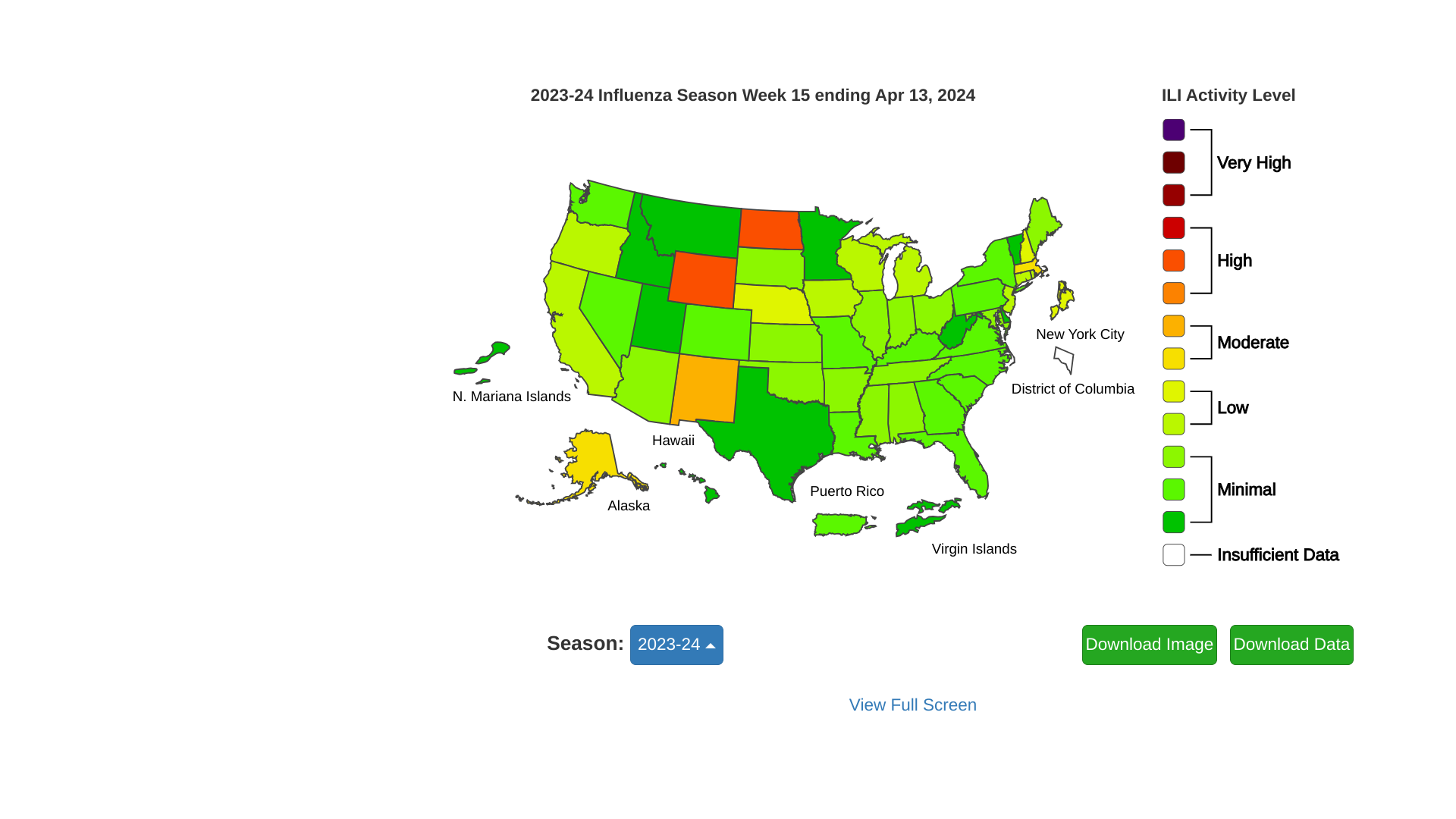
The U.S. CDC FluView report for week #15 stated seasonal influenza activity continues to decline in most areas of the United States.
Nationally, the number of weekly flu hospital admissions has been decreasing since January 2024.
Unfortunately, four influenza-associated pediatric deaths occurring during the 2023-2024 season were reported to the CDC last week, bringing the flu season total to 142 pediatric deaths.
As of April 19, 2024, the CDC recommends that everyone six months and older get an annual flu vaccine as long as influenza viruses spread.
Flu shots (egg, cell, nasal-based) can still provide benefits this season.