Search API

The U.S. National Institutes of Health (NIH) recently announced a Phase 1 trial testing the safety of an experimental nasal vaccine may provide enhanced breadth of protection against emerging variants of the SARS-CoV-2 coronavirus is now enrolling healthy adults at three sites in the United States.
Announced on July 1, 2024, the NIH is sponsoring the first-in-human trial of the investigational vaccine, which was designed and tested in pre-clinical studies by scientists from NIH’s National Institute of Allergy and Infectious Diseases (NIAID) Laboratory of Infectious Diseases.
The investigational vaccine, MPV/S-2P, uses murine pneumonia virus (MPV) as a vector to deliver a version of the SARS-CoV-2 spike protein (S-2P) stabilized in its prefusion conformation. MPV has aan affinity for epithelial cells that line the respiratory tract and may be effective in delivering vaccines to the places where natural coronavirus infections begin.
NIAID Director Jeanne M. Marrazzo, M.D., M.P.H., commented in a press release, “While first-generation COVID-19 vaccines continue to be effective at preventing severe illness, hospitalizations, and death, they are less successful at preventing infection and milder forms of disease."
"With the continual emergence of new virus variants, there is a critical need to develop next-generation COVID-19 vaccines, including nasal vaccines, that could reduce SARS-CoV-2 infections and transmission.”
This is the first NIAID clinical trial to be conducted as part of the U.S. Department of Health and Human Services Project NextGen. More information about the trial is available at clinicaltrials.gov using the identifier NCT06441968.
For the 2024-2025 season, the U.S. CDC has recommended updated COVID-19 vaccines.
Note - Link correction was completed on July 4, 2024.

The global search for innovative urinary tract infection (UTI) treatments recently received a $10 million boost.
Recce Pharmaceuticals Limited, a leading Australian developer of a new class of Synthetic Anti-Infectives, announced it had received binding commitments to raise about $10 million in new funds.
On July 2, 2024, Recce confirmed that the funds raised from the Placement will be used to advance clinical trials for intravenous use of R327 and topical applications of R327G, including Registrational Phase III clinical activities in Indonesia, Investigational New Drug (IND) enabling activities, working capital, and offer costs.
In a press release, Chief Executive Officer James Graham commented on the capital raising: "We are" delighted with the support of our capital raising from our existing shareholders and welcome new institutional shareholders to our register. We thank NorthStar Impact Fund for taking the time to understand Recce and the positive impact we aim to achieve."
Recce stated the Company will be fully funded through to FY2026 to fund significant IND-enabling clinical trials in Australia, covering intravenous and topical treatments for UTI/Urosepsis and ABSSSI, including Diabetic Foot Infections, as well as U.S. Department of Defence Burn Wound Program, Continued development of a pre-clinical portfolio, manufacturing expansion and provides the necessary capital to see Indonesian clinical trials for topical treatments through to commercialization.
On July 1, 2024, Recce clarified the Phase I/II clinical trial is an Open Label, Adaptive Design Evaluation, Crossover Study of the Safety, Pharmacokinetics and Pharmacodynamics of Various RECCE® 327 (R327) Intravenous Dose and Infusion Rates.
The primary trial outcomes were to evaluate the safety and tolerability of R327 administered at various infusion rates ranging from 15 to 45 minutes in healthy male and female participants, and to assess the plasma pharmacokinetics of R327 using the same infusion rates.
The secondary trial outcomes focused on evaluating the concentration of R327 in urine at various doses and infusion rates and examining the ex vivo pharmacodynamics, specifically the minimum inhibitory concentration, of urine and blood samples from participants. Trial outcomes were successfully achieved.
An independent data review has been conducted, and the positive safety and efficacy conclusions stated in the announcement released on June 28, 2024. A comprehensive data review will be conducted, with results to be made available to the Company, which are expected to align with findings to date.
In the United States, And in the United States, Pivya™ (pivmecillinam) recently gained the Food and Drug Administration (FDA) approval for treating adult women with uncomplicated UTIs. Pivya's availability in the U.S. is forecasted for 2025.

Voices of Alzheimer's, a national advocacy organization led by people living with Alzheimer's disease, today announced it celebrates the U.S. Food and Drug Administration's (FDA) decision to grant traditional approval of donanemab (Kisunla) for treating early Alzheimer's disease.
Following last year's first-ever traditional approval of a drug to slow the progression of Alzheimer's, today's decision builds on that progress by providing patients, care partners, and providers with another alternative to care during the early stages of the disease.
While Kisunla is not a cure, new treatment options still bring tremendous hope to affected families and offer priceless additional time for people in the early stages of Alzheimer's disease.
Jim Taylor, President & CEO of Voices of Alzheimer's and husband to Geri, who was diagnosed with Alzheimer's in 2012, said in a press release on July 2, 2024, "Today is a day for celebration in the Alzheimer's community. When doctors diagnosed my wife Geri with Alzheimer's, there was not a single approved treatment to slow the progression of the disease."
"Now, a decade later, we have two traditionally approved disease-modifying treatments and further advancements in the pipeline."
Taylor continued, "I am also encouraged by the evidence supporting stopping treatment with Kisunla when amyloid plaques are removed."
"People living with Alzheimer's and their care partners already face significant costs and burdens in their day-to-day lives. The possibility of stopping treatment could translate to lower costs and a reduced treatment burden."
In light of this news, Voices of Alzheimer's reiterates our call for the Centers for Medicare and Medicaid Services to remove coverage with evidence development requirements for the entire class of monoclonal antibody treatments for Alzheimer's.
The total cost of Kisunla will vary by patient based on when they complete treatment, says Eli Lilly.
Lilly Support Services for Kisunla is a free support program committed to helping patients navigate treatment with Kisunla. The program includes coverage determination assistance, care coordination, nurse navigator support, customized support, and resources. For more information, visit www.Kisunla.Lilly.com or call 1-800-LillyRx (1-800-545-5979).
Alzheimer's disease preventive vaccine candidates continue to be researched in clinical trials.

Despite the World Health Organization declaring an end to the recent pandemic about a year ago, COVID-19 remains a significant health risk for immunocompromised patients.
To address this unmet need, AstraZeneca today announced its Marketing Authorisation Application for sipavibart (AZD3152), an investigational long-acting monoclonal antibody, has been accepted under an accelerated assessment procedure by the European Medicines Agency (EMA) for preventing COVID-19 in immunocompromised patients.
This passive immunization is essential for immunocompromised patients who often do not respond adequately to vaccination alone and remain at high risk of serious outcomes from COVID-19.
Prof. Paul Loubet, M.D., Ph.D., MPH, Professor of infectious diseases, University of Montpellier, head of the Infectious and Tropical Diseases Department, Nîmes University Hospital, France, and SUPERNOVA clinical trial investigator, said in a press release on July 1, 2024, “The disease burden of COVID-19 remains high for immunocompromised patients who are disproportionately impacted compared to the general population, despite vaccination."
"With cases expected to rise in the winter months, adding more pressure to stretched healthcare systems, sipavibart has the potential to be an important option for immunocompromised patients who remain at risk, and it has demonstrated COVID-19 protection in a mixed variant environment.”
In addition to the EMA, AstraZeneca is in dialogue with other regulatory authorities on potential authorization or approval pathways for sipavibart.

In the past two years, H5 influenza virus subtypes have caused severe disease in birds and mammals in the United States. Because of various media reports, there is concern about the risk of these viruses spreading to humans, which could generate another pandemic.
On June 27, 2024, the U.S. Centers for Disease Control and Prevention (CDC) confirmed that the risk to people is very low. However, the U.S. government continues its multi-year effort to prepare for this risk.
Moderna, Inc. today announced a project award of $176 million to accelerate the development of mRNA-based pandemic influenza vaccines. The award program is within the U.S. Department of Health and Human Services (HHS).
The project award will support the late-stage development of an mRNA-based vaccine to enable the licensure of a pre-pandemic vaccine against the H5 influenza virus.
This new HHS agreement also includes additional options to prepare and accelerate responses to future public health threats.
"mRNA vaccine technology offers advantages in efficacy, speed of development, and production scalability and reliability in addressing infectious disease outbreaks, as demonstrated during the COVID-19 pandemic," said Stéphane Bancel, Chief Executive Officer of Moderna, in a press release on July 2, 2024.
In July 2023, Moderna initiated a Phase 1/2 study to generate safety and immunogenicity data for the investigational pandemic influenza vaccine (mRNA-1018) in healthy adults. The study includes vaccine candidates against H5 and H7 avian influenza viruses.
Results from the study are expected in 2024 and will inform Phase 3 development plans.
Currently, there are U.S. FDA-approved pandemic vaccines (Audenz) and various development initiatives underway, funded by the U.S. government.
Furthermore, the CDC has confirmed annual flu shots may not be effective against these influenza subtypes.

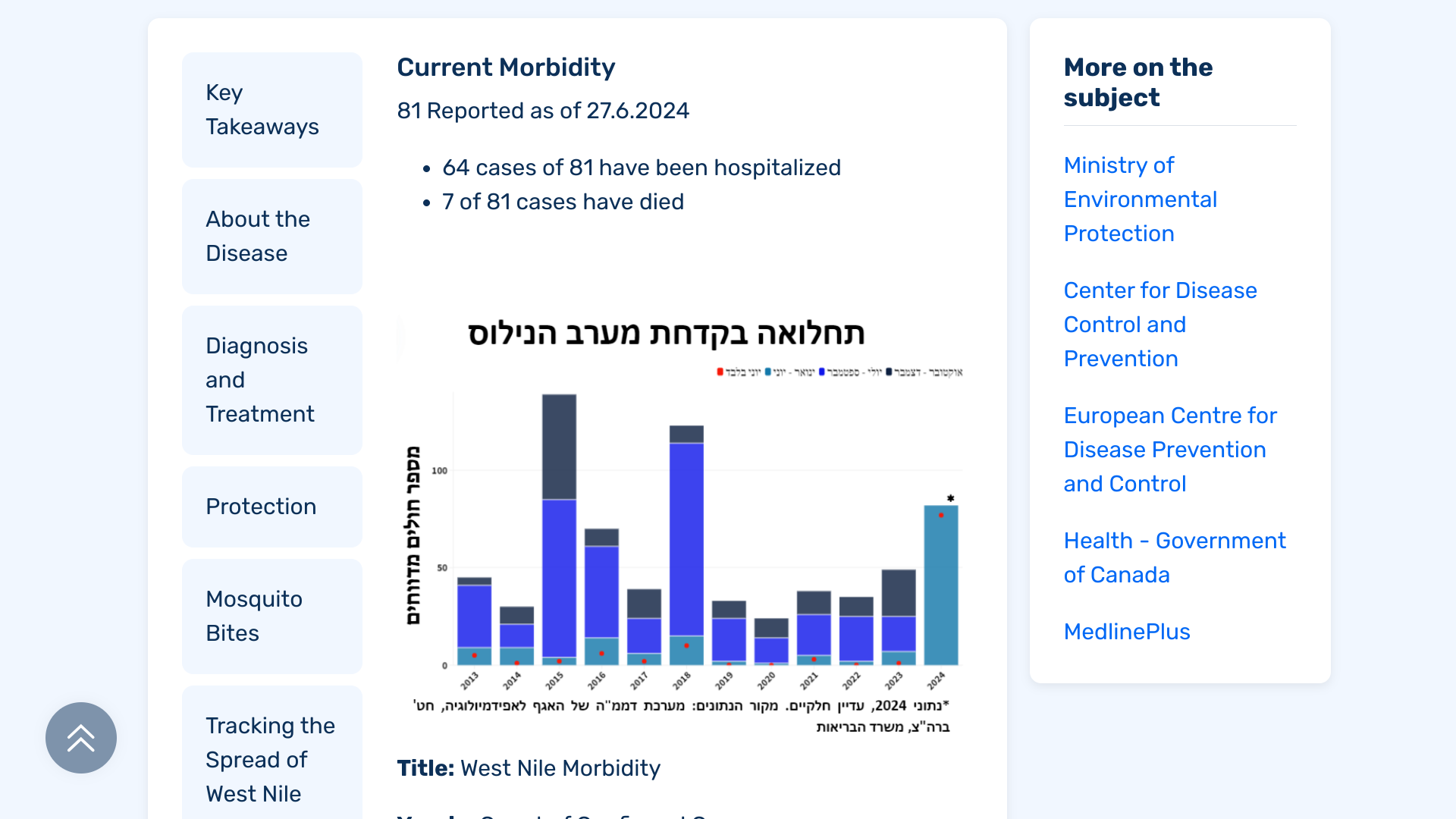
West Nile fever cases have been reported in Israel for many years and generally occur between June and November each year. That annual trend changed in 2024, with fatal cases reported earlier than usual.
The Israeli Ministry of Health (MOH) recently reported that 81 people have been diagnosed with West Nile fever in 2024. Sixty-four people have been hospitalized.
As of July 1, 2024, a total of 7 people who were diagnosed with the virus died.
All of these West Nile cases have been reported in the center of Israel.
The MOH says the risk of significant morbidity is among older adults and people with immunosuppression.
To reduce exposure to mosquitoes, the MOH recommends using mosquito repellents and appropriate measures to keep mosquitoes away in living rooms, as well as turning on fans in the place of residence.
The U.S. CDC says there are no licensed vaccines or medicines to prevent or treat West Nile virus in humans. However, several vaccine candidates have shown safety and immunogenicity in clinical trials.
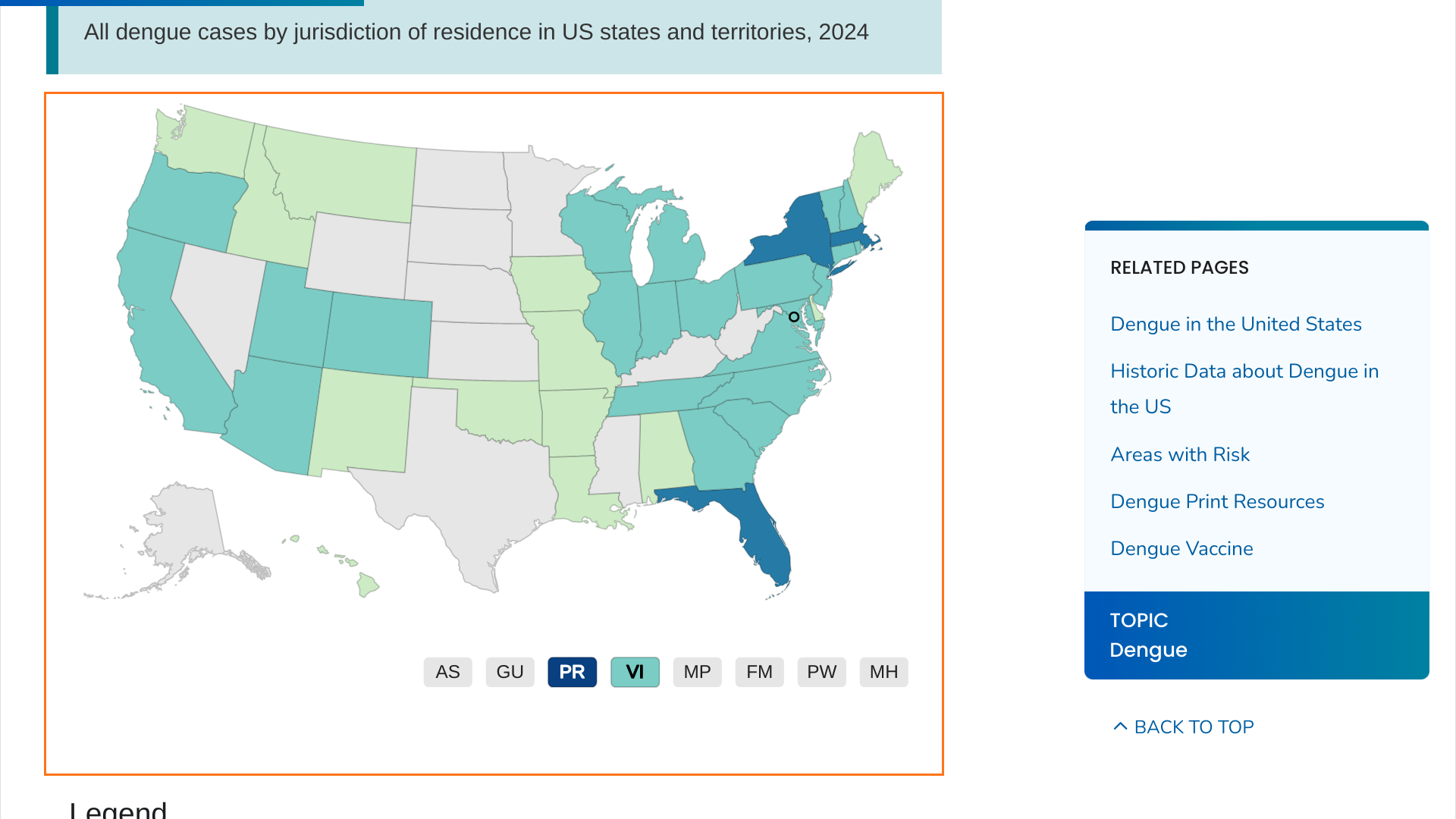
When the U.S. Centers for Disease Control and Prevention (CDC) published a Health Advisory (CDCHAN-00511) on June 25, 2024, it indicated that dengue fever posed a health risk in southeast Florida, New York, and Puerto Rico.
However, according to new CDC data, Massachusetts has reported 50 dengue cases this year.
While the CDC did not disclose whether these dengue cases were locally acquired, it can be assumed that they are travel-related since the mosquitoes that spread dengue are not found that far north in the United States.
However, countries in the Region of the Americas have reported a record-breaking number of dengue cases, exceeding the highest number ever recorded in a single year.
From a local guidance perspective, the Massachusetts Health Department (MDH) says there is no vaccine (Dengvaxia is no longer available in the U.S.); the best way to protect yourself is to not get bitten by mosquitoes.
MDH's website states if you have recently traveled to a region where mosquito-borne diseases are common and have any related symptoms, you should call your healthcare provider immediately and explain your travel history and symptoms.
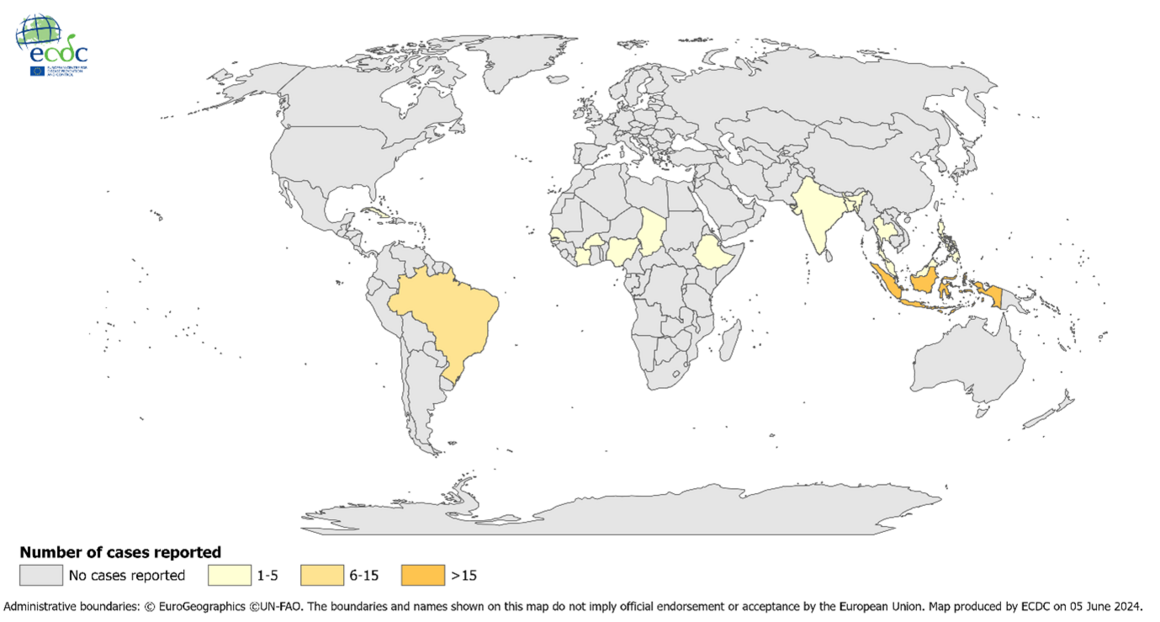
Valneva SE announced today that the European Commission (EC) has granted marketing authorization in Europe for the IXCHIQ® vaccine, which is used to prevent diseases caused by the chikungunya virus in adults.
IXCHIQ® is the world’s only licensed chikungunya vaccine.
The EC decision marks the third approval the Company has received for IXCHIQ® following approval from the U.S. FDA in late 2023 and Health Canada last month.
On July 1, 2024, Valneva stated it expects to deliver the first vaccine doses in Europe in the fourth quarter of 2024.
Juan Carlos Jaramillo, M.D., Chief Medical Officer of Valneva, commented in a press release, “The EC approval marks a crucial milestone toward making this vaccine available to as many European citizens as possible .... It is critical to provide a vaccine solution not only to European travelers going to endemic chikungunya areas, such as South America or Africa.
Valneva has also submitted a Marketing Authorization Application to the UK Medicines and Healthcare products Regulatory Agency and the Brazilian Health Regulatory Agency, with potential approval in 2024.