Search API

Recent Highly Pathogenic Avian Influenza (HAPI) outbreaks in Europe have led France to issue a 'high' alert, forcing poultry farms to keep birds indoors as of December 5, 2023.
The French government wrote, 'continuing strong dynamic of HPAI virus infection recorded in Europe, while the first contamination of a farm had been detected a few days ago in France, has now led the public authorities to place all of the territories at high-risk levels with of HPAI.'
The French Ministry of Agriculture and Food Sovereignty launched a vaccination campaign in October 2023 to reduce the spread of HAPI. The mandatory vaccination of domestic ducks applies to all of Metropolitan France (except Corsica Island).
To better inform the public, the Ministry has published 'Ten Things to Remember About HAPI Vaccination' (posted in French) on November 17, 2023.
Avian influenza, known as bird flu, is harmless in cooked food and spreads among various types of birds, mammals, and even to humans.
Furthermore, the World Health Organization report #907 confirmed sporadic influenza A(H5N1) clade 2.3.4.4b virus detections in humans.
On September 29, 2023, the U.S. government announced that it restricted the import of poultry from France and its European Union trading partners following France's decision to vaccinate meat ducks against HPAI.
Additionally, the U.S. Centers for Disease Control and Prevention (CDC) published a Technical Report in 2023 that confirmed the overall risk to human health associated with the ongoing outbreaks of highly pathogenic A(H5N1) viruses remains low.
From an outbreak protection perspective, the CDC confirmed in June 2023 that about 20 million H5N1 and 12 million H7N9 vaccines for humans were available in the U.S. National Strategic Stockpile.
Note: This article was updated on Dec. 7, 2023.

Novavax, Inc. today announced that Health Canada has granted expanded authorization for Nuvaxovid™ XBB.1.5 Vaccine (Recombinant protein, Adjuvanted) for active immunization to prevent COVID-19 caused by the SARS-CoV-2 coronavirus in individuals aged 12 and older.
The Public Health Agency of Canada's National Advisory Committee on Immunization recommended XBB COVID-19 vaccines that target more recent, immune-evasive virus variants.
The expanded authorization was based on non-clinical data showing that Novavax's COVID-19 vaccine induced functional immune responses against XBB.1.5, XBB.1.16, and XBB.2.3 variants.
Additional non-clinical data demonstrated that Novavax's vaccine-induced neutralizing antibody responses to subvariants BA.2.86, EG.5.1, FL.1.5.1, and XBB.1.16.6 as well as CD4+ polyfunctional cellular (T-cell) responses against EG.5.1 and XBB.1.16.6.
These data indicate that Novavax's vaccine can stimulate both arms of the immune system and may induce a broad response against currently circulating variants.
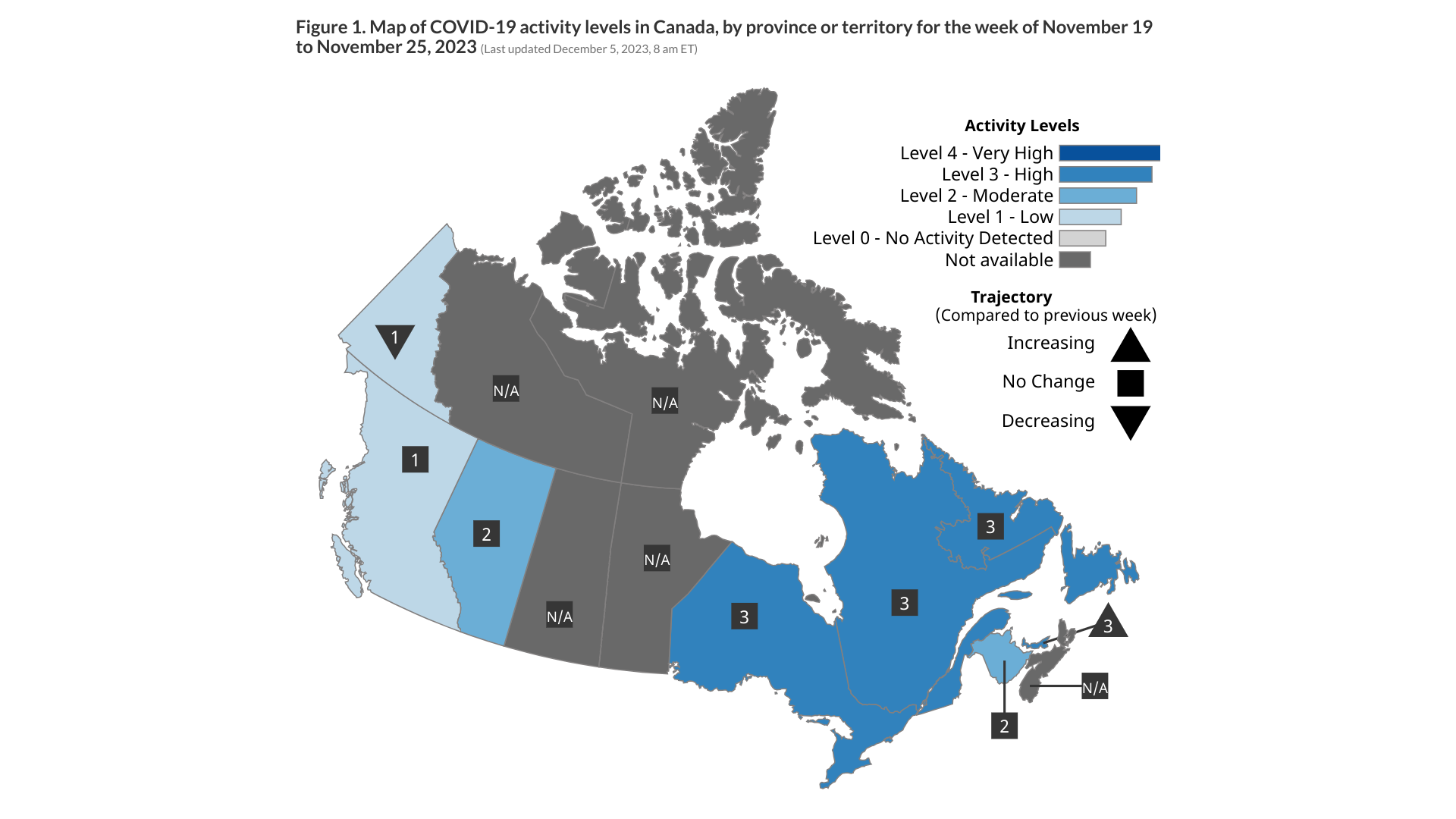
In Canada, recombinant XBB sub-lineages remain dominant, representing 93% of sequences in the past month. HV.1, HK.3, and BA.2.86 (including JN.1) are the major lineage groups demonstrating consistent growth in Canada.
Health Canada's latest COVID-19 numbers were updated at this link as of December 5, 2023, 8 am ET.
"Today's expanded authorization will support the Canadian government's strong commitment to provide its citizens with effective options, such as our protein-based non-mRNA vaccine, in the campaign against currently circulating COVID-19 variants," said John C. Jacobs, President and Chief Executive Officer, Novavax, in a press release on December 5, 2023.
Novavax's updated COVID-19 vaccine is also authorized in the U.S. and Europe by the World Health Organization and is under review in other markets.
Vaxcyte, Inc. today announced the publication of the results from the VAX-24 vaccine candidate's pneumococcal disease (PD) proof-of-concept study in the journal The Lancet Infectious Diseases.
This phase 1/2 clinical trial evaluated the safety, tolerability, and immunogenicity of Vaxcyte's investigational 24-valent, carrier-sparing pneumococcal conjugate vaccine (PCV) compared to the current standard-of-care, Prevnar 20® (PCV20, APEXXNAR), for the prevention of invasive pneumococcal disease (IPD) in healthy adults.
The study results showed that VAX-24 demonstrated a safety and tolerability profile comparable to PCV20 at all doses studied and an immunogenicity profile that met or exceeded established regulatory immunogenicity standards for all 24 serotypes at the conventional 2.2 mcg dose.
"The results from the proof-of-concept study provided the first look at the safety and immunogenicity profile of VAX-24 in adults, giving us confidence in the 2.2 mcg dose we plan to advance into Phase 3," said Dr. Jakub Simon, Chief Medical Officer of Vaxcyte, in a press release on December 4, 2023.
"We look forward to initiating our Phase 3 pivotal, non-inferiority study, designed to further establish the clinical potential of VAX-24, and announcing topline data, which we expect in 2025."
PD is an infection caused by Streptococcus pneumoniae bacteria, says the U.S. CDC.
It can result in IPD, including meningitis and bacteremia, and non-invasive PD, including pneumonia, otitis media, and sinusitis.
People can get pneumococcal disease more than once. A previous pneumococcal infection will not protect you from future infection. Therefore, CDC recommends pneumococcal vaccination even if someone has had pneumococcal disease in the past.
In the United States, approximately 320,000 people get pneumococcal pneumonia each year, which is estimated to result in about 150,000 hospitalizations and 5,000 deaths.
Pneumococci also cause over 50% of all cases of bacterial meningitis in the U.S.
As of December 2023, several approved pneumococcal vaccines are available at clinics and pharmacies in the U.S.

Osivax today announced that it has received a grant of over $1.5 million from the U.S. National Institute of Allergy and Infectious Diseases (NIAID).
The grant will support preclinical studies evaluating the breadth of protection and immune response induced by OVX836 against pandemic influenza strains.
OVX836 is a first-in-class influenza vaccine candidate that targets the nucleoprotein (NP), a highly conserved internal antigen. Unlike surface antigens, the NP is much less likely to mutate, providing a broader and more universal immune response.
OVX836 will be evaluated against two pandemic influenza A-strains in preclinical models: the once pandemic but now seasonal, pH1N1, and the highly pathogenic variant with pandemic potential, H5N1.
Osivax’s oligoDOM® technology enables the design and production of a recombinant version of the NP, which self-assembles into a nanoparticle, thus triggering powerful T- and B-cell immune responses.
OVX836 has been tested in 5 clinical trials with 1200 participants, showing promising safety, immunogenicity, and efficacy read-outs.
“Receiving this grant from the NIAID will support our progress in developing OVX836 to provide broad-spectrum protection against influenza, which remains a perennial pandemic threat,” commented Alexandre Le Vert, Co-Founder and CEO of Osivax, in a December 5, 2023 press release.
“We believe that by generating these additional data against pandemic influenza strains, we will be able to bolster the positive results generated by OVX836 against seasonal strains, placing us on a strategic path toward future regulatory approval.”
Osivax also recently published the results of a Phase 2a dose-optimization study (OVX836-003) in The Lancet Infectious Diseases, showing efficacy in humans against seasonal strains.

With the winter months ahead, most hikers are not focused on catching Lyme disease. However, once the snow melts, millions of people will once again not have access to a vaccine.
There are currently no approved human vaccines for Lyme disease.
To address this significant health risk, Pfizer Inc. and Valneva SE today announced that they have completed recruitment for the Phase 3 clinical trial Vaccine Against Lyme for Outdoor Recreationists (VALOR) for Lyme disease vaccine candidate VLA15.
The VALOR trial, initiated in August 2022, has enrolled 9,437 participants five years of age and older at sites where Lyme disease is highly endemic across the U.S., Europe, and Canada.
As part of the primary vaccination series, participants receive three doses of VLA15 or a saline placebo (1:1 ratio) within the first year and one booster dose approximately one year after completion of the primary immunization.
The trial builds on previous positive Phase 1 and 2 trial results and includes adult and pediatric participants to confirm the efficacy, safety, lot consistency, and immunogenicity of VLA15.
"Lyme disease is the most prevalent vector-borne infectious disease in the United States and Europe, can sometimes even lead to long-lasting consequences," said Annaliesa Anderson, Ph.D., Senior Vice President and Head Vaccine Research and Development, Pfizer, in a press release on December 4, 2023.
"If approved, a vaccine could prevent the disease and ease the burden of acute, severe, and sometimes persistent consequences in adults and children."
"We look forward to progressing the trial with the goal of submitting a Biologics License Application to the U.S. Food and Drug Administration and Marketing Authorization Application to the European Medicines Agency in 2026, subject to positive data."
VLA15 is an alum-adjuvanted formulation administered intramuscularly and has demonstrated a strong immune response and a satisfactory safety profile in pre-clinical and clinical trials.
This investigational multivalent protein subunit vaccine uses an established mechanism of action for a Lyme disease vaccine that targets the outer surface protein A (OspA) of Borrelia burgdorferi, the bacteria that cause Lyme disease.
OspA is a surface protein the bacteria expresses when present in a tick. Blocking OspA inhibits the bacterium's ability to leave the tick and infect humans.
The vaccine candidate covers the six most common OspA serotypes expressed by the Borrelia burgdorferi sensu lato species prevalent in North America and Europe.


Valneva SE today announced positive antibody persistence data twenty-four months after vaccination with a single dose of its chikungunya vaccine IXCHIQ®.
As reported on December 4, 2023, 97% of the 316 healthy adults still enrolled in a phase 3 study retained neutralizing antibody titers above the seroresponse threshold.
The persistence of antibodies in older adults aged 65 and above was as robust as in younger adults and even slightly higher in terms of geometric mean titers and seroconversion rates.
This outcome underscores the vaccine's potential to offer strong and lasting protection against chikungunya across different age groups.
Juan Carlos Jaramillo, M.D., Chief Medical Officer of Valneva, said, "We are very pleased about these twenty-four-month data, which confirm IXCHIQ®'s ability to induce a robust, long-lasting antibody response in both younger and older adults with a single vaccination."
"Being the world's first approved vaccine against chikungunya, each positive outcome further strengthens the defense against this significant and expanding public health threat."
These results from VLA1553-303 follow the completion of the pivotal Phase 3 study published in the Lancet in which a seroresponse rate of 96% six months after a single vaccination1 was reported.
Valneva was granted U.S. FDA approval for IXCHIQ in November 2023, and two marketing applications are currently under review by Europe and Canada, with potential approvals in mid-2024.
The U.S. CDC intends to review the use of IXCHIQ in 2024.
The World Health Organization says the chikungunya virus was identified in over 100 countries, and 340 related deaths have been reported in the past year.
